This could be a great idea for Asbury Park. Cargo bikes are appearing to be the “old is new again” great way to get goods and services around in cities as cars have threatened to take over our streets, and city leaders strive to make streets safer for bicyclists and pedestrians. Bike manufacturers are trying to keep up with the demand for cargo bikes, and building bikes are lighter and easier to pedal than old versions. A seemingly not too difficult challenge is for cities to establish areas for delivery trucks to reload goods to the cargo bikes.
Tactical Urbanism=A Bit Naughty For A Purpose
Meet Happy Streets: Rotterdam’s cheeky activists for social mobility in the city
A cheerful squad of urban agitators are using Rotterdam to conduct quirky experiments in social mobility.
A fun approach
Happy Streets’ playful approach to tackling the problem is refreshing. Recent projects have included creating a temporary bike lane with painted yellow dots to demonstrate that there is room for cyclists, converting parking slots to astro-turfed picnic areas furnished with benches and deck chairs, and creating a pavement version of the game Twister. Such projects have encouraged residents and policy makers to take another look at the purposing of city spaces, and consider alternative, less car-centric models. Tactical urbanism, it seems, is spreading. In one part of town – quite independent of Happy Streets – local residents recently took matters into their own hands and painted their own pedestrian crossing to show that they needed one. ‘I thought that it was really nice that people are sometimes a bit disobedient, not because they want to make a mess, but because they just want to make the city a better place,’ says Wemmenhove. ‘We need to trust people a bit more that they also know what they’re doing.’
Read more …
#Slow The Cars
Drivers are conditioned to behave as though the roads belong to them. They’re right. Roads and streets have been designed for cars, pushing aside other users and causing injury and death. Cities now realize that speed kills, and they’re rethinking design and infrastructure, and especially slowing the cars. #slowthecars
Taming Speed for Safety: Portland Case Study
Fortunately, many leaders are stepping up to modernize and improve they way they manage speed, including upstream efforts to address the underlying systems, policies, and the built environment that influences speed.
HOW BIKE LANES BENEFIT BUSINESSES
We are gradually seeing improvements on the condition of streets around Asbury Park, better crosswalks and traffic signals, and of course the work being done on Rt 71, Main Street. Most business owners are ready to welcome a safer Main Street, but for those who still have reservations…
“In city after city, business owners are seeing more customers come through their doors and more revenue flowing into cash registers when streets are redesigned to be more walk- and bike-friendly.
HOW BIKE LANES BENEFIT BUSINESSES
“Picture the busiest, most successful shopping districts in America. Think Michigan Avenue in downtown Chicago or Pike Place Market in Seattle. Are these areas filled with parking lots and parking spaces? No. They’re filled with people walking around from store to store.”
Protected bike lanes create an environment where pedestrians feel safer walking and cars still have easy access to shops along the street. (Source: Green Lane Project)
Read more…
https://www.strongtowns.org/journal/2018/5/31/how-bike-lanes-benefit-businesses
Parking Is Sexy Now
Asbury Park and cities all over the world acknowledge that parking has to come with a higher pricetag, and that walking, bicycling, and alternative and mass transportation must be incentivized and supported.
Parking Is Sexy Now. Thank Donald Shoup.
In an interview, the guru of progressive parking policy reflects on his decades of research and writing, which transformed how cities look at the curb.
LAURA BLISS May 30, 2018
Thanks to Shoup and his many students, we know that cars cruising for on-street parking in American downtowns account for roughly 1,825 vehicle-miles traveled, for each curb space, every year—two-thirds the length of the country. We know that parking covers an astonishing percentage of urban land area (14 percent in housing-crunched Los Angeles county); that parking inflates the cost of housing and goods because developers fold it into property costs; and that when the city foots the bill for “free” parking, it’s a public subsidy to the affluent—non-car owning people are gifted no such real estate.
The High Cost of Free Parking, Shoup’s 2005 book, is often called “revolutionary” for turning an otherwise dry academic topic into a high-stakes urban issue. In the 500-page follow-up, Parking and the City, Shoup compiles and reviews the newest research on parking’s oft-invisible effects. He also shows the way to rein them in. Through real-world case studies and research projects, Shoup makes three central recommendations for cities: eliminate planning codes that require developers to build off-street parking, charge the correct prices for on-street parking throughout the day, and spend parking meter revenue to make visible improvements on metered streets.
Read more…
https://www.citylab.com/amp/article/560876/?__twitter_impression=true
TRAFFIC CALMING 101
Walking Emancipation
“In almost all U.S. cities, the bulk of the right-of-way is given to the roadway for vehicles, the least to the sidewalk for pedestrians… just suppose that Americans were to extend their walking radius by only a few hundred feet. The result could be an emancipation… –William H. Whyte (CITY: Rediscovering the Center)
Developed in Europe, traffic calming (a direct translation of the German “vekehrsberuhigung”) is a system of design and management strategies that aim to balance traffic on streets with other uses. It is founded on the idea that streets should help create and preserve a sense of place, that their purpose is for people to walk, stroll, look, gaze, meet, play, shop and even work alongside cars – but not dominated by them.
Read more…
https://www.pps.org/article/livememtraffic
Madrid Takes Its Car Ban to the Next Level
THINK BANNING CARS WILL LEAD TO ECONOMIC LOSSES? THINK AGAIN.

The only vehicles that will be allowed in this zone are cars that belong to residents who live there, zero-emissions delivery vehicles, taxis, and public transit. Even on a continent where many cities are scaling back car access, the plan is drastic.
Read more…
https://www.citylab.com/transportation/2018/05/madrid-spain-car-ban-city-center/561155/
Portland’s Design Guide for Protected Bike Lanes
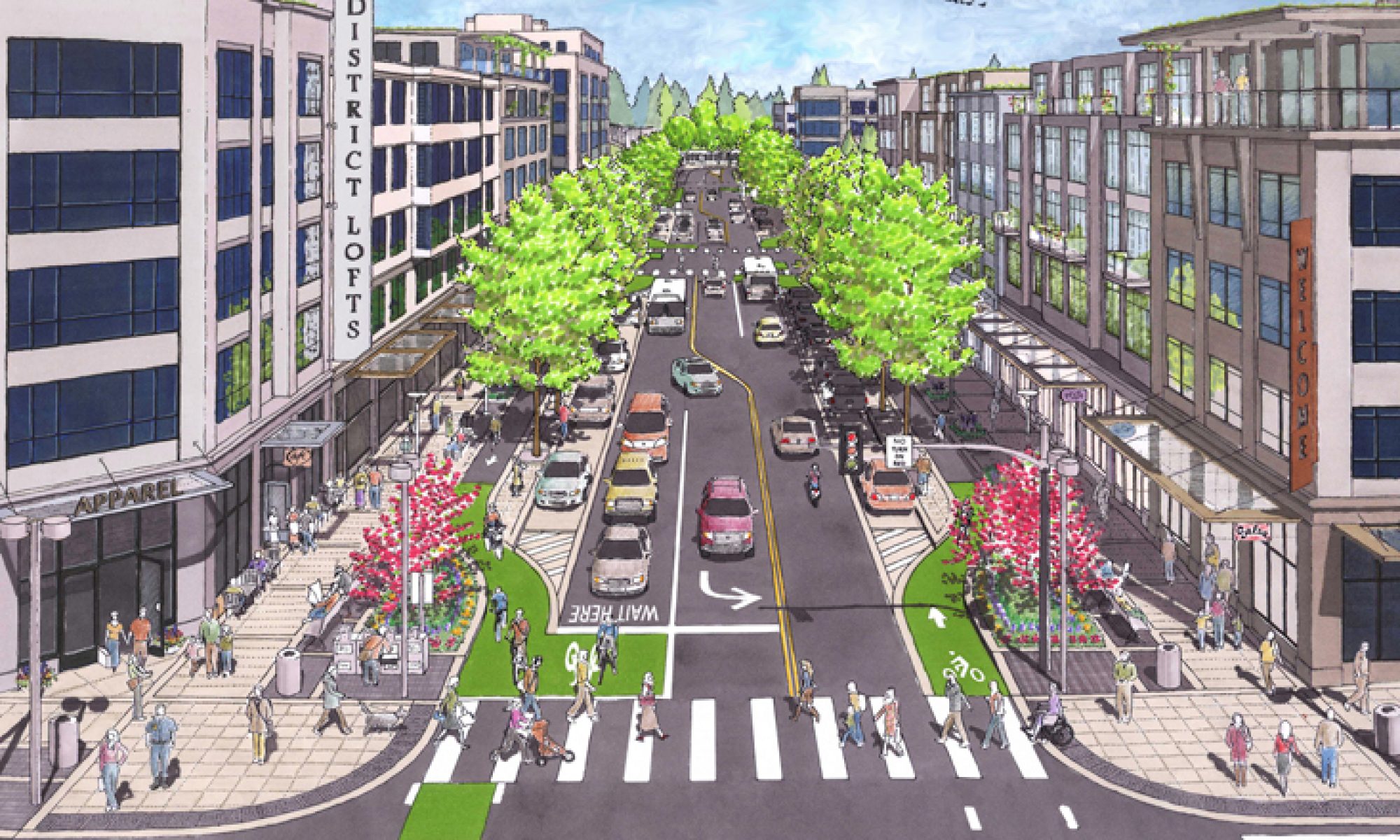
Asbury Park Complete Streets Coalition has a vision of a network of bike lanes connecting every neighborhood of the city. It won’t happen overnight, but let’s think about how we want these bike lanes to function. We can learn from cities like Portland that are a few years ahead of us in designing for bikes. See if you can identify the same configuration as Asbury Park’s Main Street.
Posted by Jonathan Maus (Publisher/Editor) on May 23rd, 2018
One of the (many) reasons for the slow implementation of protected bike lanes is that engineers, planners, and project managers at the Portland Bureau of Transportation haven’t been reading from the same book. In fact, they haven’t even had a book. Until now.Portland has been talking about physically protected bike lanes for years. The problem is, we’ve mostly just been talking — and not building. And when we have built them, the designs have been inconsistent.
Last week PBOT’s bicycle program manager Roger Geller shared a sneak peek at a new manual that will soon be adopted as the official Portland Protected Bicycle Lane Design Guide.
Read more…
UN World Bicycle Day, June 3rd, 2018
How long has it been since you’ve ridden a bike? Do you have a bike gathering dust in your basement or garage, or do you ride often for fun, exercise, or transportation and don’t even think about how revolutionary and important bicycles are? Bikes have been around for hundreds of years, and continue to be the most economical and sensible way to get around cities, yet we have allowed automobiles to take over our lives (and real estate) on city streets and neighborhoods. Our suburbs are literally covered in asphalt. Let’s get on a bikes on June 3rd and make a statement for bicycling in every community in the US!
On June 3, 2018, the first official World Bicycle Day will be celebrated.
Acknowledging the uniqueness, longevity and versatility of the bicycle, which has been in use for two centuries, and that it is a simple, affordable, reliable, clean and environmentally fit sustainable means of transportation, fostering environmental stewardship and health, the General Assembly decided to declare 3 June World Bicycle Day.
Why celebrate the bicycle?
- The bicycle is a simple, affordable, reliable, clean and environmentally fit sustainable means of transportation;
- The bicycle can serve as a tool for development and as a means not just of transportation but also of access to education, health care and sport;
- The synergy between the bicycle and the user fosters creativity and social engagement and gives the user an immediate awareness of the local environment;
- The bicycle is a symbol of sustainable transportation and conveys a positive message to foster sustainable consumption and production, and has a positive impact on climate.

Read more…
News! Electric Car-Share and Jitney Service Coming To Asbury Park
Mobility, access, and reduction of parking problems and congestion for residents and visitors: Asbury Park is about to launch an electric car-share and jitney service!
JITNEY SERVICE AND ELECTRIC CAR SHARE PLANS MOVE FORWARD
The Asbury Park City Council is in the final stages of developing two new programs that will help stay parking and traffic congestion with in the 1.4 square mile increasingly popular beach community.
Read more…
http://asburyparksun.com/transportation-innovation-continues-in-asbury-park/