Here’s fascinating history on how we’ve been brainwashed, explained in Peter Norton’s book, Fighting Traffic: The Dawn of the Motor Age in the American City. “In ad after ad during the Super Bowl, auto companies… have long promised us nirvana. And we’ve blindly shilled out our life savings” to buy, insure, maintain and park cars. The 1920s program at Harvard taught “the first generation of traffic engineers to prioritize traffic lights for faster driving and more difficult walking.”
We need to use language and educate to make sure messages like “biking is normal,” “walkability,” and “good transportation choices” become better understood and more widely accepted over the next decade.
The conversation continues about scooters, “…as a transportation choice – and other micro mobility vehicles are not a novelty, and we should give everything we can to helping them succeed.”
To take back our streets, remember how we lost them to cars
Ford Motor’s “Road of Tomorrow” from the 1939 World Fair
Streets are now thoroughly car-centric, and the idea of people-centered streets remains a difficult concept for most people to grasp. These groups recognized they needed to shift the perceived cause of collisions away from drivers and onto pedestrians. Under the name Motordom, the interest groups were quoted in a 1922 edition of Engineering News-Record that they would lead the effort in a “revision of our concept of what a city street is for.”
A 1937 anti-jaywalking ad from the Federal Art Project. Source
As Mike Manzella, AP transportation manager reported at the Homeowners’ meeting, scooter use has massively surpassed the use of bike share since the September 2019 launch. This is the case in cities all over the world where scooters have been introduced. With the huge increase in scooter usage there is a rise in injuries, but not because of the scooters themselves, or the people riding them. We’re overlooking the real problem, which is too much space for cars.
People have been brainwashed by the auto industry that roads belong to drivers since cars started to become ubiquitous beginning in the 20’s. Roads quickly became the domain of drivers, to the exclusion of all other users, as the industry subtly and not subtly used ad campaigns and articles to influence the populace. Walkers and bike riders were designated to move within narrow painted lines, people walking outside lines are called jaywalkers, and they’re blamed for being hit by drivers. The number of people killed by drivers is growing. “More pedestrians and cyclists were killed last year in the United States than in any year since 1990.”
Now scooter riders share the narrow painted spaces allocated to bike riders, and as the newcomers to streets, they’re the new focus of culpability and safety concerns. #toomanycars #slowthecars
“The rise of the e-scooter has been meteoric, eclipsing bike share usage nationally in 2018, just a year after gaining widespread availability, according to a recent report by NACTO, a national association of city officials. But that doesn’t mean the scooters had anywhere to go — except onto roadways where drivers believe they are the sole legitimate user.”
The Real Reasons Scooter Injuries Are Exploding
It’s not time to quash the micromobility revolution. It’s time to build a world where micromobility riders stand a chance on our streets.
By Kea Wilson
Photo: Nathan Rupert/Flickr
Scooter injuries are up more than 200 percent over the last four years — but everyone is blaming the wrong people.
The Jan. 8 report from JAMA Surgery does not offer much context for the 222-percent increase in scooter fatalities between 2014 and 2018, which has allowed news outlets to fill the gap with alarmist articles decrying the lack of scooter regulation, lack of helmet usage, and more.
The rides are monthly community events open to everyone, residents and friends of Asbury Park. Helmets are required for those under age 17. The rides last from 60-90 minutes.
“We stop along the way for photos, very easy,” said organizer Polli Schildge, a member of the Asbury Park Complete Streets Coalition. “We ride when it’s cold and even once with snow on the roads!”
Schildge said that rides are not held in precipitation, however, and those gatherings are rescheduled.
Email apcompletestreets@gmail.com to get on the mailing list for the monthly Slow Roll, or for more information. Visit the Complete Streets Coalition Facebook page for more information about biking, walking and alternative transportation in Asbury Park, as well as transportation initiatives elsewhere.
The group has been been meeting at The Carousel for the past several rides because of its central location. But Schildge says she’s “happy to begin rides anywhere that will attract the most people to get together on bikes — any age, any kind of bike for an easy cruise around Asbury Park.”
In most American cities, bike and walk advocates beg for validation and funding like a “charity case”, and end up getting acknowledged and funded as such, resulting in insufficient or piecemeal infrastructure. We commonly see bike lanes that abruptly end, unprotected bike lanes that don’t offer leading bicycle intervals or leading pedestrian intervals (LPIs and LBIs), or safe left turns, and painted lines “that put cyclists between fast-moving traffic and parked cars with doors that capriciously swing open”, so only experienced riders will brave them, and discouraging new riders. This kind of bike and walk design and implementation continues to give drivers the sense of entitlement that roads are intended for them, and discourages people from riding bikes, scooters, and walking, thereby creating more traffic congestion perpetuating the inherent safety, health, and environmental issues.
As advocates for safe, complete streets, do we dare to go big to make environmental, social, and safety gains we hope to achieve? If American bike and walk advocates are “pitching ourselves as a niche, special-interest group”, we are “tacitly agreeing that cars are and should be the dominant mode of transportation…”
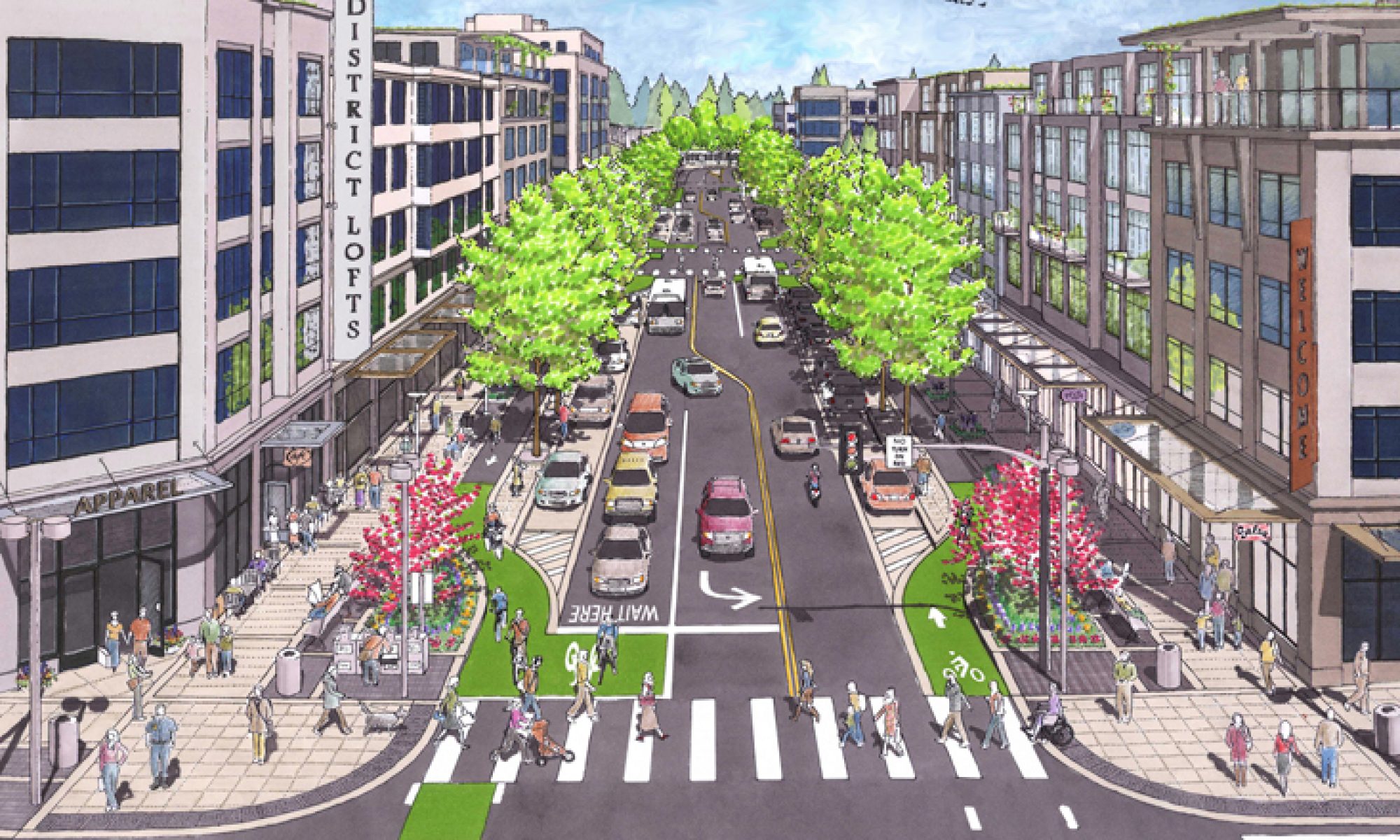
The auto industry has dominated since the 1930s by promoting plans for highways and streets for cars. Asbury Park is a 1.4 mile square city, where we have envisioned a plan for biking and walking, a network of infrastructure that can be a model for cities all over the US. Let’s do it big. Onward to 2020 and beyond!
Why We Need to Dream Bigger Than Bike Lanes
In the 1930s big auto dreamed up freeways and demanded massive car infrastructure. Micromobility needs its own Futurama—one where cars are marginalized.
A cyclist rides on the bike lane in the Mid Market neighborhood during Bike to Work Day in San Francisco, California May 14, 2015. REUTERS/Robert Galbraith –Protected bike lanes are often the most ambitious component of reform proposals. They should be a mere starting point.Robert Galbraith/ReutersOur current model is to beg for twigs
“More often than not, bike infrastructure is created reactively. Typically in response to a collision or near collision with a car, an individual or advocacy group identifies a single route that needs better infrastructure. We gather community support and lobby local officials for the desired change, trying as hard as we can to ask for the cheapest, smallest changes so that our requests will be seen as realistic.
What’s the problem with this model?
It’s like imagining a bridge and asking for twigs—useless, unable to bear any meaningful weight, easily broken. And it’s treating bike infrastructure like a hopeless charity case.
This makes bike infrastructure seem like a small, special-interest demand that produces no real results in terms of shifting to sustainable transportation, and it makes those giving up road space and tax dollars feel as though they are supporting a hopeless charity.
But when roads, highways, and bridges are designed and built, they aren’t done one neighborhood at a time, one city-council approval at a time. We don’t build a few miles of track, or lay down some asphalt wherever there is “local support” and then leave 10-mile gaps in between.”
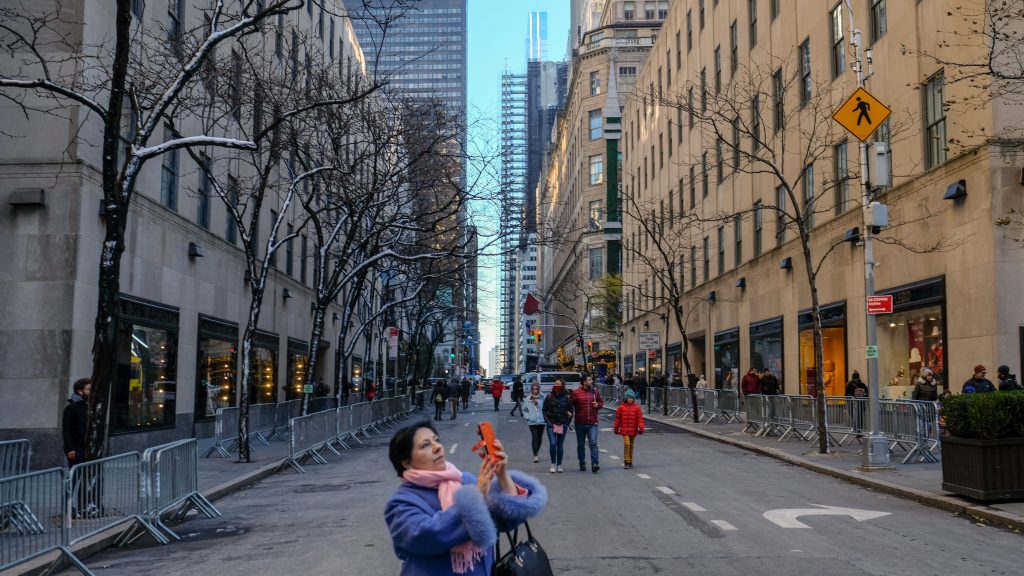
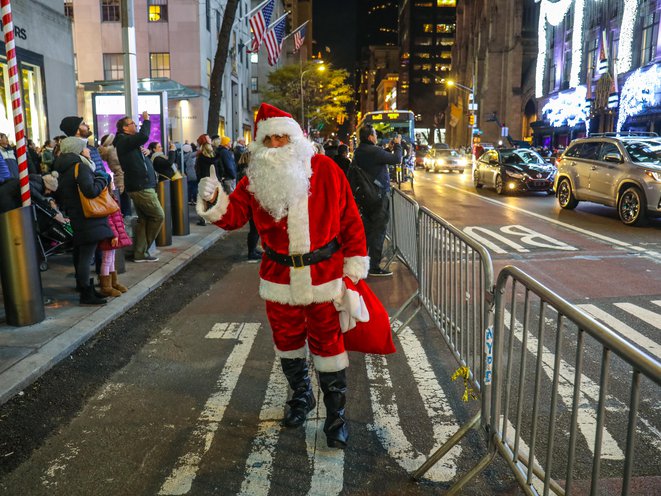
Strolling around Rockefeller Plaza is a pleasure for visitors this Christmas season. NYC went through the expected bureaucratic machinations, but finally did it. Streets are walkable, and cars are marginalized (at least temporarily), and even the naysayers have changed their tune, enjoying the friendliness and lack of traffic congestion. Cities all over the world are re-imagining their relationship with cars and re-designing for people. We can begin to see this becoming a reality in Asbury Park. Onward, looking forward to a people-centered city. Happy 2020 and beyond!
Visitors and workers in Rockerfeller Center venture out into car-free 49th and 50th streets to get a better glimpse of Rockefeller Center on Tuesday, Dec. 3, 2019. The city has implemented new temporary closures of cross streets and lanes along Fifth Avenue in order to better accommodate a growing number of visitors to the area during the holidays.
“Less is more, regarding traffic,” said Joe Friedman, a Connecticut resident who commutes to Rockefeller Center for his job in television production as he took a break on 49th Street. “There’s usually much more congestion and you’re fighting for space all the time.”
On the ground, the pilot program was, unsurprisingly, a huge hit with the people walking in the middle of the street. “We’re from Oklahoma, and this is great!”, one of the tourists told Gothamist. “I hope they do this with more streets,” said an Upper West Side woman out shopping with her daughter. “It’s so nice to have to have some space, and not have to worry about cars.” Even the one guy I found who may have had a legitimate reason to be irritated by the change, a Baldor’s driver on delivery who had to park his truck two blocks away and hand truck his produce in instead of pulling into the Rock Center garage, was not at all annoyed. “Look at all the happy people,” he told me. “Taking pictures, holding hands… it’s beautiful.”
The industry has systematically blinded us since the 1920s, and many drivers and city leaders passionately defend the condition. Even though cars are literally killing us, it’s common to hear and read about drivers, business owners, delivery services, and emergency service providers arguing against proposed bike lanes and other infrastructure for micromobility (the ongoing fights in NYC about bike lanes reducing parking, and constant bashing of e-scooters), and complaints about insufficient parking. The onus is placed on the most vulnerable road users for their own safety, with programs aimed at walkers and bicyclists suggesting (or mandating) hi-viz gear, flags, eye contact, of course helmets for all bike riders, and staying within painted lines. Drivers are routinely absolved of responsibility by law enforcement and journalists in crashes involving people on bikes or walking, because the person wasn’t wearing a helmet or wasn’t in the bike lane or crosswalk (as if a helmet will prevent being hit by a car, or that paint magically protects bike riders and walkers – did you know that jaywalking is fake?). APCSC is thankful for Asbury Park city leaders who envision streets that prioritize people, not cars. This is a process that will take time as it has in cities all over the world, but Asbury Park is truly becoming a people-oriented city.
“This is the first in a series of four articles discussing car blindness. For cities around the world, more urgency is needed to enable sustainable, efficient, and healthy transport.”
Car blindness — Ignoring the true cost of cars
Alex Dyer Aug 24
Car blindness
Car blindness is the mindset of not seeing that cars themselves are a major, chronic problem. It is when one overlooks the heavy price tag of driving cars and is unable to see the precariousness of car dependency.
A symptom of car blindness is being convinced that by fixing one or two problems, cars will finally make sense.
Maybe by changing how they‘re powered will fix them? Or maybe making them a tiny bit less dangerous? Or making non-dangerous road users, like cyclists, more visible? Or adding another lane to a highway, or tunnel through a city?
NJDOT has money available for walking and biking projects, but small towns and municipalities find it very difficult to access the funds. NJDOT claims that there are not many projects in the pipeline — NOT TRUE.
“New Jersey has the second-highest amount of uncommitted federal transportation dollars in the nation, and it consistently ranks among the worst when it comes to spending a specific type of transportation funds — Transportation Alternatives, which is intended to fund trails, walking, and biking projects. ”
As of last week in NJ, at least 165 people have been killed in 2019 while walking or bicycling. In 2018, New Jersey State Police reported that bicyclists and pedestrians comprised 34% of the state’s crash fatalities.
NJDOT has a responsibility to make the funds available for biking and walking projects in cities like Asbury Park.
Dozens are killed each year walking and biking in N.J. We have the cash to make roads safer. | Opinion
By Star-Ledger Guest Columnist
Sonia Szczesna and Liz Sewell
As of Dec. 9, 2019, at least 165 people have been killed this year while walking or bicycling on New Jersey’s roads. Meanwhile, New Jersey has millions in federal transportation funds it can spend, Sonia Szczesna and Liz Sewell say.
New Jersey has the second-highest amount of uncommitted federal transportation dollars in the nation, and it consistently ranks among the worst when it comes to spending a specific type of transportation funds — Transportation Alternatives, which is intended to fund trails, walking, and biking projects.
At the same time New Jersey has a backlog of transportation dollars to spend, it has an enormous bicycle and pedestrian safety problem. As of Dec. 9, 2019, at least 165 people have been killed this year while walking or bicycling on New Jersey’s roads. In 2018, New Jersey State Police reported that bicyclists and pedestrians comprised 34% of the state’s crash fatalities — the second deadliest year for walkers and bikers on record. The deadliest year was in 2017.
Ads for SUVs are so attractive. Families loading camping gear, young couples off-roading in the snow, kids piling out to soccer practice … and in all of the ads there’s NO traffic anywhere. The automotive industry is banking on sales of big vehicles for the bigger profit margin. GAs is relatively cheap, Americans are eagerly buying into the hype, and killing more people walking, on scooters, and on bikes in greater numbers every day. Young suburban moms are driving these huge vehicles with one or two kids (or alone) so we don’t want to blame men entirely, but hey guys. Honestly do you need a truck to make a statement?
DOT: Men in Big SUVs Are a Menace to Society
By Gersh Kuntzman
“We have met the enemy and it is men.”
“The popularity of SUVs and light trucks are contributing to the increase in roadway fatalities in New York City and nationally,” DOT Commissioner Polly Trottenberg. “If you’re behind the wheel of one of those vehicles … you need to take extra caution. it has a lot more weight…poor visibility, it takes you longer to brake and it is harder to see around turns. Drivers of those vehicles need drive very carefully to compensate.”
Are you influenced by the ad campaigns for an SUV? Red about it:
Cities that prioritize parking and roads for automotive traffic have bought into the hype. It’s the influence of the addiction, and it’s especially hard to break an addiction when the addicts don’t know, or are unwilling to admit that they’re addicted.
The 3 leading causes of death in the US, guns, opioids, and car crash fatalities. The industries are profiting, and they’re killing us in almost equal numbers by keeping us addicted.
One way that the media has bought into the hype is putting the onus for safety on people riding bikes and scooters, which is focusing entirely on the wrong problem. #toomanycars#slowthecars
Asbury Park Complete Streets Coalition works to address the health, economic, and equity of transportation options in our city.
The truly most dangerous activity :
“…separates white from black, rich from poor, healthy from sick…when you cram yourself into a little steel box. The structure is designed to keep you emotionally and financially enslaved to your car…”
THE MOST DANGEROUS ACTIVITY
Another reason it’s popular to talk about the dangers of cycling is that talking about the dangers of cycling discourages people from cycling. American society doesn’t want YOU on a bike. If YOU start riding, you will drive less. If you drive less, you’ll contribute less to the structure we live in, which is built around driving.
Read this blog post by Seth Davidson, a long-time bicycle rider, advocate, and cycling lawyer. He’s often snarkily humorous, but this time he’s deadly serious:
Scooters, (and micro-mobility in general) have become a legitimate part of plans for many cities all over the world to fulfill objectives to reduce car-dependency, thereby mitigating pollution, and saving lives due to vehicular crashes.
Paul Steely White, after 14 years leading Transportation Alternatives, is now taking on a new role as director of safety policy and advocacy at Bird, an electric scooter rental company. He has been New York City’s most vocal champions of pedestrians, cyclists and public transit.
White tweeted: “This is the 2nd time in 2 weeks that someone who should have known better has grossly misreported the UCLA scooter study. “50x more injuries” is not the same as 50 more injuries (vs. bikes).”
We tweeted in reply: “This kind of reporting is obviously focusing on the wrong issue. Can’t help wondering whether they’re funded by the automotive industry.”
Journalists have taken up the issue of scooter dangers. So let’s play a game. Read this article (or any article about the dangers of scooters, where the writer is cautioning about the numbers of injuries, helmet use, etc. and substitute the word “car” for “scooter.” Let’s keep this number top of mind: 40,000 people were killed last year in vehicular crashes.
E-SCOOTERS PRESENT A GROWING PUBLIC-HEALTH CHALLENGE
BY DR. JONATHAN FIELDING, OPINION CONTRIBUTOR
This movement may be good for clearing the air, easing automobile congestion and building valuation (Bird and Lime are worth about $2B each), but municipalities, manufacturers and sharing companies need to address pressing safety, health and environmental problems already taking root.
That need becomes urgent as e-scooter popularity skyrockets. In 2018, shared e-scooter and bicycle trips in the U.S. more than doubled over 2017’s baseline to reach 84 million; rentable e- scooters alone accounted for more than 38.5 million trips.
Growing injuries match the growing popularity. Many emergency rooms have reported leaps in e-scooter injuries, causing several municipalities to ban their use. There’s an increased acknowledgement that safety concerns present a major barrier to mass adoption, as companies face fresh regulatory pushback and litigation risk amid reports of vehicle malfunctions and deaths.







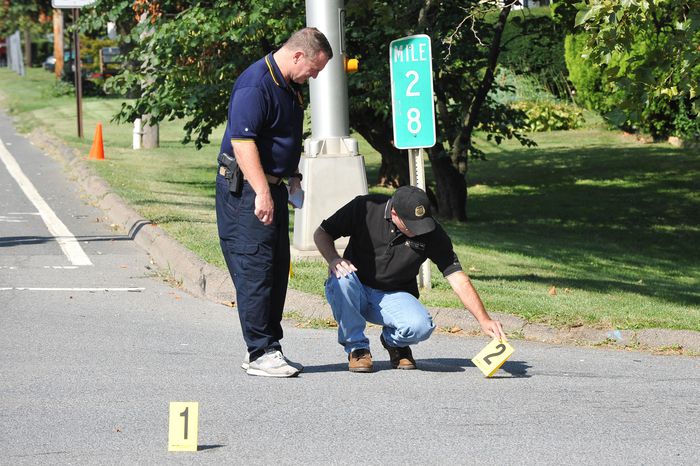


New Jersey has the second-highest amount of uncommitted federal transportation dollars in the nation, and it consistently ranks among the worst when it comes to spending a specific type of transportation funds — Transportation Alternatives, which is intended to fund trails, walking, and biking projects.
At the same time New Jersey has a backlog of transportation dollars to spend, it has an enormous bicycle and pedestrian safety problem. As of Dec. 9, 2019, at least 165 people have been killed this year while walking or bicycling on New Jersey’s roads. In 2018, New Jersey State Police reported that bicyclists and pedestrians comprised 34% of the state’s crash fatalities — the second deadliest year for walkers and bikers on record. The deadliest year was in 2017.
Read more…
https://www.nj.com/opinion/2019/12/dozens-are-killed-each-year-walking-and-biking-in-nj-we-have-the-cash-to-make-roads-safer-opinion.html?fbclid=IwAR20L1WLdGy92nbip0OWW9rWj91zCvWQ0R5jgzHqlyuZ0bL6QR3UG-5Nyx0