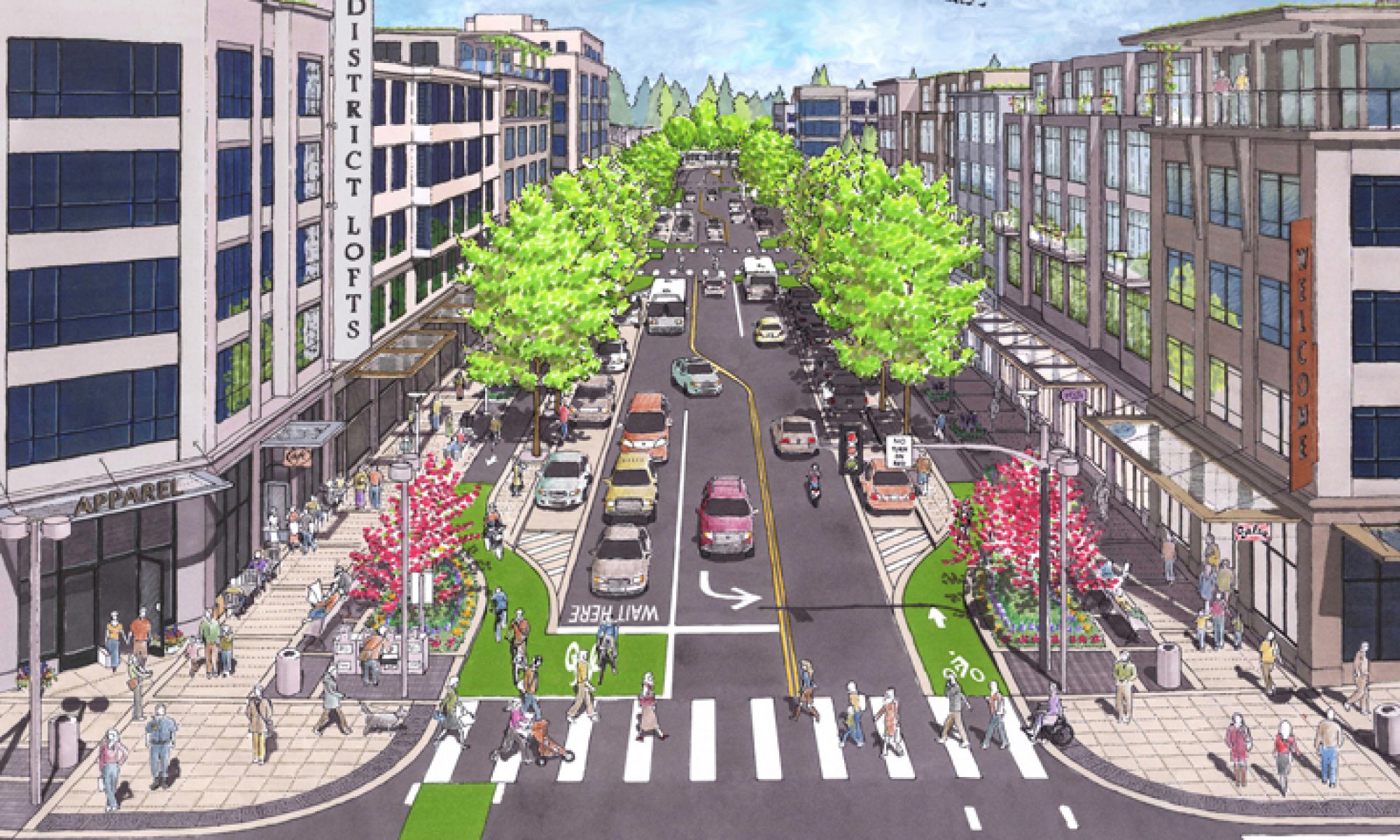
To build an inclusive smart city, look through an age-friendly lens

Active aging. Aging in place.  As the Boomer generation is aging, these are desirable characteristics of a well-designed city. It has infrastructure in place so that elderly don’t have to drive to shop, to church, recreational activities, or dining.  A walkable and bike-able city is a safe city, and Asbury Park Complete Streets advocates for streets that are safe for an 8-year-old or an 88-year-old. Asbury Park is perfectly positioned with streets being paved and sewers being repaired to put in place new and better infrastructure and transportation options for everyone.

As the aging population expands, some cities are implementing strategic plans to ensure the needs of the elderly are met — especially in terms of mobility and housing.

“Comprehensive plans really are the opportunity for a community to come together and connect all the dots that comprise a healthy, livable place,” said Danielle Arigoni, director of livable communities for AARP. Leaders can “stitch together the connections that exist between housing and how people get around, between infrastructure investments and … whether or not there’s pedestrian infrastructure in place,” she said.

Read more…

https://www.smartcitiesdive.com/news/to-build-an-inclusive-smart-city-look-through-an-age-friendly-lens/514328/

No Street Is “Complete” Without Taking Equity Into Account

Asbury Park Complete Streets Coalition focuses on Equity.  Many residents in AP do not own cars and move about the city on foot, on bikes, or with wheelchairs.  Streets are complete when they are safe for the most vulnerable: streets that are safe for an 8-year-old or an 88-year old.  

By meeting the needs of underserved communities – lower-income, elderly, immigrants, etc., Complete Streets implementation can be geared towards the needs of those residents and not simply those of neighborhood newcomers.

The article points out that underserved communities disproportionately bear the brunt of pedestrian and bicycle injuries, yet typically receive fewer infrastructure enhancements:  improved crosswalks, narrower travel lanes, better lighting, bike amenities, street trees, etc.  The updated policy metrics steer cities towards reducing the disparity between vulnerable users and street improvements.  As advocates, it’s our job to communicate the idea that CS improvements are intended to serve our vulnerable communities, not displace them.  

For 10 years, the National Complete Streets Coalition has scored thousands of “complete streets” proposals from around the U.S. This year, for the first time, they’re including equity and diversity outcomes as part of their grading rubric.

Weeks ago, on November 19, activists and mourning families in cities around the U.S gathered in public squares for the World Day of Remembrance for Traffic Victims. There, they heard how many people were injured on their city’s streets each month of the year; the names of the dead were read out loud.

To date, over 18 U.S. cities have joined the Vision Zero initiative–a multi-national effort to bring the number of traffic deaths down to zero through a combination of street-design projects and policy. But still, the number of traffic fatalities keeps rising in the U.S. From 2015 to 2016, the number of pedestrian deaths increased 11% to around 6,000–the biggest-ever single-year increase in pedestrian fatalities. Cyclist deaths are also on the rise.

Read more…


Senate Bill to Put Bicycle and Pedestrian Education in the NJ Driver Manual

Improve Driver Education in New Jersey with Senate Bill 2894!

Click here to sign!

http://p2a.co/a2nyrz8

Christie has to sign on to get bicyclist and pedestrian safety information in the NJ Driver Manual by JANUARY 16.  He has a pile of bills on his desk so let’s get this one to the top!

This bill will improve safety on roads for everyone.   It requires the New Jersey Driver Education Course, Driver’s Education Manual, and written exam to include bicyclist and pedestrian safety information.

Bike riders and pedestrians in New Jersey are not safe on our roads!

Our state ranks among the highest in the nation for bike rider and pedestrian road fatalities. It’s time that drivers learned that our roads are for bike riders and pedestrians also.

Senate bill 2894 requires the New Jersey driver education course, driver’s education manual, and driver’s license written exam to include bicyclist and pedestrian safety information.

Click here to sign!

http://p2a.co/a2nyrz8

Both the Senate and the Assembly have passed S2894/A4165.

Now it is time for Governor Christie to sign this bill into law. He has until January 16th to sign the bill; otherwise, it will expire and we must begin all over again to get this bill through both the Assembly and the Senate. Click to send a message to Governor Christie that now is the time to start making our roads safer, and a good beginning is educating new drivers, including teenagers, on their responsibilities toward bike riders and pedestrians.

The NJ Bike & Walk Coalition, Bicycle Coalition of Greater Philadelphia, and the League of American Bicyclists support this bill and ask you to speak up!

Click here to sign!

http://p2a.co/a2nyrz8

The silly unintended consequences of mandatory helmet laws

A bit off-topic from our snow focused posts lately, but let’s talk about something that comes up constantly and will be a subject as soon as snow melts.  HELMETS.  Kids on bikes under 17 are required by law to wear helmets.  In some states adults on bikes are required to wear helmets.  What do you think?  Should motorists be required to wear helmets?

Check it out.

“It is becoming abundantly clear there is far more safety in numbers than Styrofoam. Studies report that doubling the number of cyclists results in a one-third reduction in the number of car-bike collisions. And as Brent Toderian, a former Vancouver city planner and helmet law critic, stated at an SFU roundtable discussion last month: “There is no doubt that the safest thing for cyclists is more cyclists.”

Read more…

https://www.treehugger.com/bikes/silly-unintended-consequences-mandatory-helmet-laws.html

Let’s Talk About Trucks and SUVs

We Know SUV Design Kills Pedestrians, But We Still Let Carmakers Sell Them

“Why are companies allowed to sell mass market vehicles with such a huge blind spot in front that children are rendered invisible? Where are the regulators at the National Highway Traffic Safety Administration?The specific dangers of SUVs have been out in the open for a long time, and it’s no secret that pedestrians are at particular risk.”

Read more…

https://usa.streetsblog.org/2017/10/19/we-know-suv-design-kills-pedestrians-but-we-still-let-carmakers-sell-them/

Pedestrians: wear bright or reflective clothing, remove earbuds, make eye contact with drivers, cross only at crosswalks, never talk, text or use electronic devices in an intersection. Drivers: carry on.
A review of a BIG truck…

https://www.theglobeandmail.com/globe-drive/reviews/new-cars/an-inside-look-at-truck-culture-and-fords-supersizedmegaraptor/article37429371/

Inspiration! Calling for Sneckdown photos in AP!

Sneckdowns!  Neckdowns+snow.  This is the way streets need to be designed.  Take a walk around your neighborhood in Asbury Park and take some pics–pedestrians and cars moving about in the city more slowly.  Cars are slower and people are safer.  We have at least a week (or more) of cold weather to collect some great shots. Email your photos to apcompletestreets@gmail.com and we’ll post them!

From Clarence Ekerson, dedicated director of Streetfilms.

Here’s about 90 seconds of inspiration for you to get out and document your streets after the snow has fallen to create – space that can be redistributed to pedestrians. With predicted low temps next week, they’ll be out there for days!

Check out the video:

https://twitter.com/PurpleClarence/status/948933157050515456

Portland is Completely Overrated as a Bike City.

Even a city like Portland  that is lauded for bike infrastructure is deemed lacking by Mikael Colville-Andersen, .one of the most well-known bicycling and urban planning consultants in the world.”

Why?

He says, “It is a car city that squeezed some bike facilities in. Almost reluctantly, it seems.”

This doesn’t have to be the case in Asbury Park.

Harsh words for Portland after a visit over the holidays.

In an Instagram post yesterday, Mikael Colville-Andersen wrote that, “Portland is completely overrated as a bike city” and that “It is a car city that squeezed some bike facilities in. Almost reluctantly, it seems.”

Read more…https://bikeportland.org/2018/01/03/colville-andersen-portland-is-completely-overrated-as-a-bike-city-263331

St. Louis Calms Traffic With Heavy Concrete Globes

Cities are finding cost-effective ways to calm traffic.  Not surprising that motorists are not happy, but people are safer.

“This particular configuration, where the bollards are placed in the roadbed to make car turns tighter and shorten crossing distances, is relatively new for St. Louis. Some people may not like the way they look, but the globes are a cost-effective solution to dangerously designed streets.”

Read more…https://usa.streetsblog.org/2018/01/04/st-louis-calms-traffic-with-heavy-concrete-globes/

‘A rolling walking stick’: why do so many disabled people cycle

Riding a bike may be easier than walking for two-thirds of disabled cyclists, but they often remain invisible to society. 

In the context of an ageing global population, mobility experts are increasingly seeing cycling as a way to help people with disabilities move around cities independently. A bike can act as a “rolling walking stick”; yet looking at its owner you wouldn’t know they had a disability: around 40% of disabled cyclists simply use a regular two-wheeled bike.

For two out of three disabled cyclists, riding a bike is easier than walking, easing joint strain, aiding balance and relieving breathing difficulties. According to recent research by Transport for London, 78% of disabled people are able to cycle, while 15% sometimes use a bike to get around.

Read more…

https://www.theguardian.com/cities/2018/jan/02/cambridge-disabled-people-cycling-rolling-walking-stick?CMP=share_btn_fb