Streetfilms Video: A Bicycle Network. Part 1

Amazing story of how a city gets a successful bike network-and fast.

How Seville Got Its Bicycle Network

Back in 2006, Seville’s city leaders decided it was going to build a bicycle network. An expansive one, especially for a city that had very few daily riders (most claim less than a 0.5% bike mode share) and in just 18 months the city installed 80 kms of bike lanes!

They did it by commissioning a poll which found over 80% of the city’s residents thought bike lanes were a good thing and not long after the accelerated plan was set in motion. Most of the lanes were two-way protected lanes placed at grade with the sidewalk and the reaction was very positive as the city is approaching a 10% mode share.

Some of the lanes are certainly on the narrow side thanks to the numbers of riders, though there is a movement to widen them and further expand the network (see one such newer section in the Streetfilm.) But the proof on how well they work in Seville is in these irrefutable visuals: very few people wearing helmets, 35% of riders are women and there is a large component of older people riding. And for a place that is often sunny & hot – the third day I was there it was nearly 100 degrees – people still just keep riding…many of the men in business suits.

Watch video:

https://vimeo.com/276916492

Urban Planners Are Saving The Planet

Urban Planners Are Saving The Planet With Redesigned, Walkable Cities

BY NICOLE CALDWELL

The healthiest, most economically advantaged and sustainable cities on the planet share one trait: their walkability.

Walkable cities are better for the environment, people’s overall wellness, and positively impact levels of wealth. Unfortunately for those of us in the United States, a lot of our cities were built around cars — not feet. For as much as folks love the walkability of New York, Boston, Minneapolis, and Savannah, they dislike in equal measure the sprawl of other beloved cities like Atlanta, Los Angeles, and Dallas.

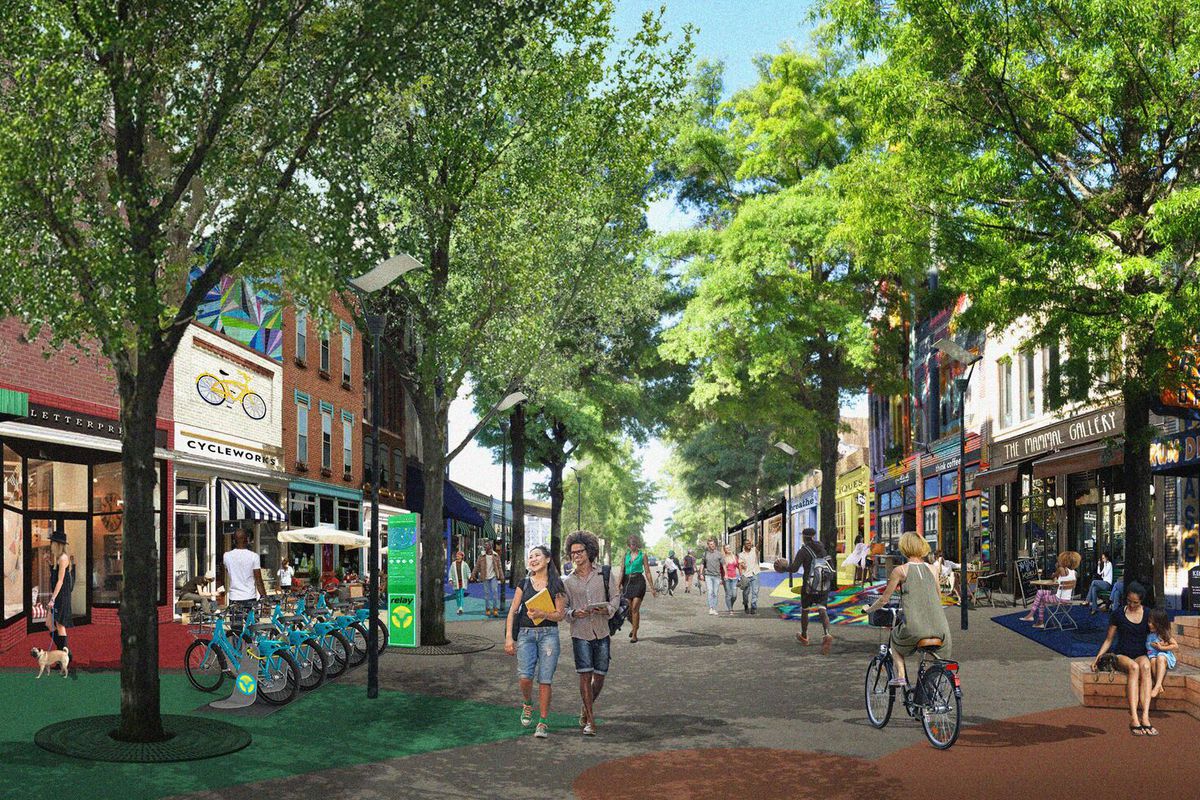
Recent pushes for healthier urban designs across the country are changing the landscape of cities. Central Park, arguably the world’s most famous green space, will be permanently closed to cars as of this June. Meanwhile Los Angeles, leader of car culture, has found itself in the throes of an “infrastructure renaissance” to become more pedestrian and eco-friendly. And 62 percent of millennials today say they prefer to live in pedestrian-friendly, mixed-use neighborhoods.

https://www.greenmatters.com/travel/2018/05/23/22PR7j/urban-planners-cities

20 Things Every City Can Do

Might seem obvious, but benches, trees, multi-modal transportation, and local food make a big difference and are a few of the suggestions in the Center for Active Design’s new Civic Design Guidelines.

20 things every city can do to boost the quality of public life

By 

Urbanists have a new playbook: The Assembly Civic Design Guidelines, a new set of recommendations for the public realm published by the Center for Active Design (CfAD)—a nonprofit that promotes design solutions for improving public health—and the Knight Foundation.

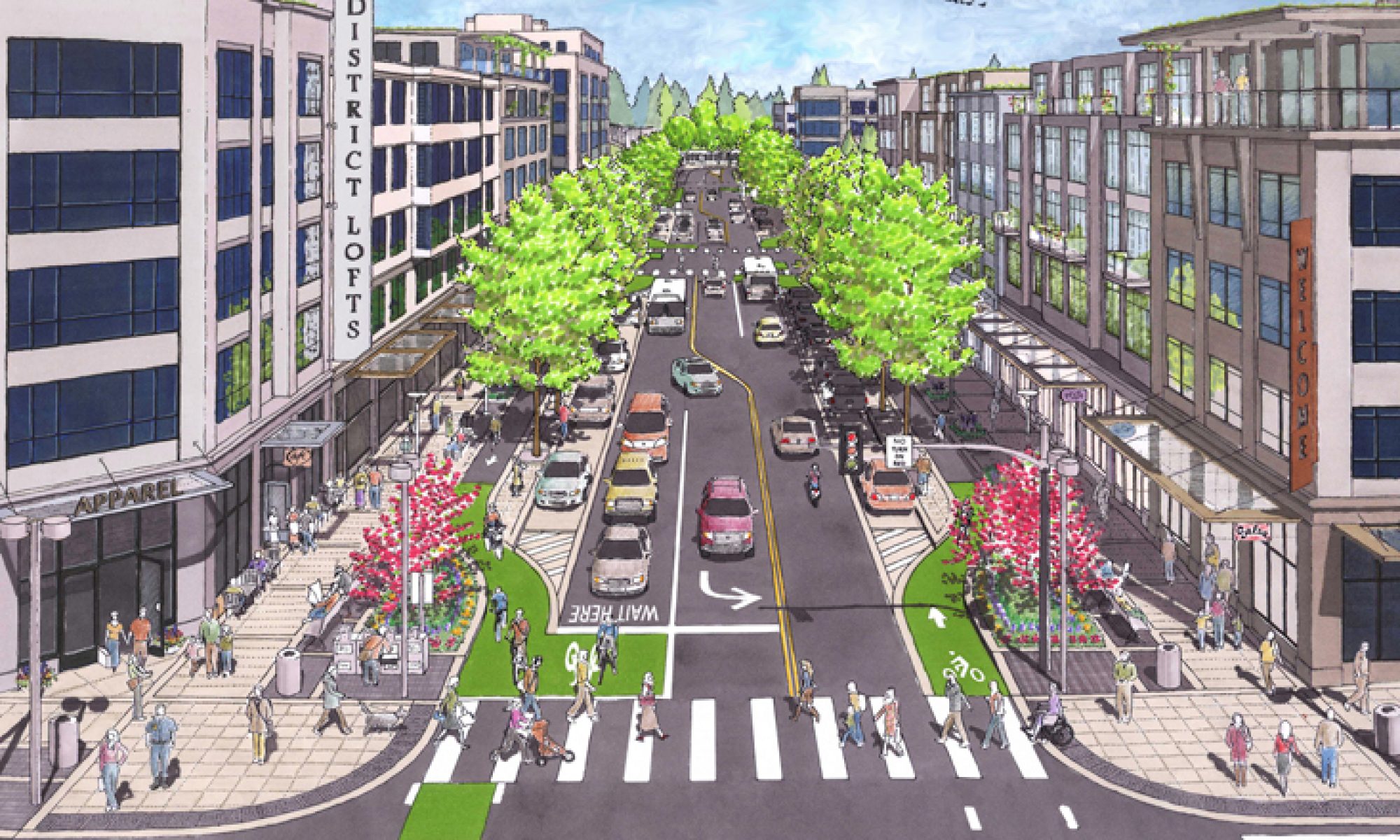
The CfAD’s recommendations might seem like old hat: plant trees, improve public transit, build more bike lanes. However, the report positions them as means to a specific end: a robust public life, which the organization defines as inspiring greater trust, participation, stewardship, and informed local voting. Plus, it has years of original research to back up the suggestions.

Read more…

https://www.curbed.com/2018/6/21/17484062/center-for-active-design-civic-guidelines

Safe Streets Academy

Even after decades of safety improvements, more people are now dying on our roadways every year, especially people walking. This happens in part because we continue to design our streets to prioritize moving cars—not people—as quickly as possible, creating a dangerous, high-speed environment for all people who use the street. To test out creative approaches to safer street design, the National Complete Streets Coalition launched the Safe Streets Academy. We worked with three cities around the country to build skills in safer street design, creative placemaking, and community engagement, then helped the cities put these skills into practice. Through demonstration projects, the City of Orlando, FL, the Lexington-Fayette Urban County Government, KY, and the City of South Bend, IN transformed their streets, intersections, and neighborhoods into slower, safer places for people. Communities around the country can learn from the stories of these demonstration projects to test out low-cost ways to create safer streets.

Through the Safe Streets Academy, three cities are build skills in safer street design, tactical urbanism, and community engagement. After our second workshop, the teams from Lexington, KY; South Bend, IN; and Orlando, FL applied these skills to launch on-the-ground demonstration projects testing techniques to slow down drivers and make their streets safer places for people.

Read more…

https://smartgrowthamerica.org/tag/safe-streets-academy/

Transportation Access For Those Most In Need

28 Jun 2018 | Posted by 

Using new mobility models to increase access

New mobility services have enormous potential to change the transportation landscape and increase access for all residents. But, only a few projects are actually focused on that.

As new mobility models continue to have an impact on our transportation system and shift how our cities are designed and operate, cities and transit agencies are launching new pilot projects to test everything from microtransit to ridesourcing to automated vehicles and understand how these services can best function in and benefit their communities.

One of the most promising areas to capitalize on new mobility services is around increasing access for people most in need; people who live in areas that are currently underserved by transit, do not have bank accounts or cell phones, require wheelchair access, or commute during off-peak hours. Depending on how they’re deployed, these services could help community members more easily reach jobs, school, medical appointments, grocery stores, or wherever people need to go.

Many of these individuals are already dealing with a transportation network that has often been designed without their needs in mind—whether it’s infrequent transit, a lack of affordability, or inconsistent paratransit options. This has grown worse in recent years as many lower-income individuals, faced with the high cost of living, have been forced to move from city centers to inner and outer ring suburbs, with fewer jobs and resources and where reliable, affordable public transportation is even less likely to exist.

Read more…

http://t4america.org/2018/06/28/using-mobility-services-to-increase-access/?utm_source=feedburner&utm_medium=email&utm_campaign=Feed%3A+transportationforamerica+%28Transportation+For+America+%28All%29%29

SUVs Kill and Fed Regulators Know It

Death on foot: America’s love of SUVs is killing pedestrians

America’s love for SUVs is killing pedestrians, and federal safety regulators have known for years.

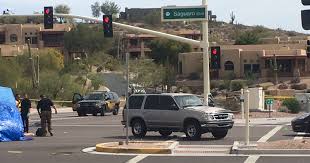
Almost 6,000 pedestrians died on or along U.S. roads in 2016 alone — nearly as many Americans as have died in combat in Iraq and Afghanistan since 2002. Data analyses by the Free Press/USA TODAY and others show that SUVs are the constant in the increase and account for a steadily growing proportion of deaths.

Our investigation found: 

  • Federal safety regulators have known for years that SUVs, with their higher front-end profile, are at least twice as likely as cars to kill the walkers, joggers and children they hit, yet have done little to reduce deaths or publicize the danger.
  • A federal proposal to factor pedestrians into vehicle safety ratings has stalled, with opposition from some automakers.
  • The rising tide of pedestrian deaths is primarily an urban plague that kills minorities at a disproportionate rate.

Read more…

https://www.freep.com/story/money/cars/2018/06/28/suvs-killing-americas-pedestrians/646139002/

Getting Rid of Cars in City Center

Idea for Asbury Park’s Business District? Tactical Urbanism taken to a new level.  It won’t happen easily, but we’re on the way to reducing parking congestion and building infrastructure and options for reducing cars.

BY EILLIE ANZILOTTI

Sneaky.  If You Can’t Ban Cars–Take Away Parking Spaces

Oslo had a plan to lower its emissions by drastically limit car travel in its center. Now you can drive, but it might not be worth it.

Instead of an outright car ban, Oslo has now announced a tactical-urbanism approach to limiting vehicle movement through the city center. [Photo: Nanisimova/iStock]

For those businesses owners concerned that the lack of parking in the central district will hamper their sales, a study of a Toronto neighborhood, previously covered by Fast Company, should give them some peace of mind. The study found that business owners drastically overestimated the percentage of their customers who arrived by car, and as such, voiced opposition to eliminating street parking in favor of more pedestrian routes and bike lanes. Visitors to the shops, on the other hand, far preferred the more humanized streets, and pedestrians and cyclists, as it turns out, were far more loyal customers, lingering longer in the shops, buying more, and exploring more outlets in the district instead of beelining back to their cars.

Read more…

http://apcompletestreets.org/wp-admin/edit.php

Stereotyping People By Their Mode of Transportation

People are not defined by what we use to get around

By 

How we choose to get around is in many ways the most personal decision we make, and one most of us have to confront in public, under dramatically different circumstances, every single day. It’s a daily calculation that takes into consideration money, safety, health, even weather conditions. But, for many of us, it’s not a lifestyle choice. It’s a matter of necessity.

Read more…

https://www.curbed.com/2018/6/27/17507250/transportation-scooters-women-bikes-families

Creative Crosswalks

June 26, 2018

Creative crosswalks: Street art meets safety enhancement

Bright colors and unique designs in crosswalks can create a sense of community while keeping pedestrians safer and drawing drivers’ attention to them.

Painted crosswalks have become ubiquitous as a pedestrian safety measure across the United States and around the world. The instantly recognizable white stripes lead pedestrians and alert drivers to pay extra attention. But a growing trend involves cities abandoning the blasé white uniform for colorful, eye-catching options that serve both as art and enhanced safety tools.

San Francisco has been at the forefront of the movement, with its well-known rainbow crosswalks in the predominantly gay Castro neighborhood. That idea is catching on in cities of varying sizes throughout the country, including PhiladelphiaSan Antonio and Maplewood, NJ.

Read more…

https://www.smartcitiesdive.com/news/creative-crosswalks-street-art-meets-safety-enhancement/526474/

What The Heck Are Sharrows?

Sharrows, or Sharing Arrows are showing up on streets in cities (Red Bank and others), and bicyclists and cars don’t know what do do with them.

BY 

MALIGNED AND MISUNDERSTOOD, SHARROWS ARE THE CAUSE OF MUCH FRUSTRATION FOR CYCLISTS AND DRIVERS ALIKE. BUT THEY CAN PLAY AN IMPORTANT ROLE—IF THEY’RE USED CORRECTLY.

For something that ought to help clarify rules of the road, the shared lane marking—more commonly known as the “sharrow”—can cause tremendous confusion. The distance between what it’s supposed to mean and how it’s actually used is a source of frustration for cyclists and drivers alike. But it doesn’t have to be this way. The sharrow, though often maligned and misunderstood, can have its proper place on our shared streets. That can only happen, however, if we understand its uses and limitations.

Recent opinion by Luisa D’Amato The Record in Ontario, Canada:


Sharrows — In Ontario those bicycle symbols on a green background that are painted on some downtown streets — are confusing and pointless. It’s time for them to go.

Read more…

https://www.therecord.com/opinion-story/8671550-d-amato-sharrows-are-a-failed-cycling-experiment/


Shared-lane markings alternating with full bike lanes in Grand Street (Manhattan)

A shared-lane marking in Toronto, Ontario, Canada


Read more…

https://www.bicycling.com/news/a20044419/what-are-sharrows-used-for/