The Asbury Park Police Department has a free, voluntary, online bicycle registration program designed to aid in returning recovered property. The registration process is quick, convenient and free.
Attention Asbury Park Residents Ages 14 Years & Older!
Submit Your Ideas for Projects to Improve Spaces in Our Community by 7/31/22
City of Asbury Park residents, ages 14 and older, can help decide how to spend $250,000 of the City’s budget by submitting their ideas for capital project to improve community spaces through the Participatory Budget Program. Ideas for improvements to parks, gardens, playground equipment, lights, sidewalks, streets, lanes, alleys, bike lanes, etc, can be submitted by 7/31/22 at www.cityofasburypark.com/pbc. Submissions will be voted on in the fall and those with the most votes will be adopted into the City’s budget.
“The Participatory Budget program aims to promote equity and empowerment and increase civic engagement,” said Councilperson Eileen Chapman, “It gives all residents, including our youth who aren’t traditionally able to participate in government, an opportunity to make a real impact and help improve our community spaces.”
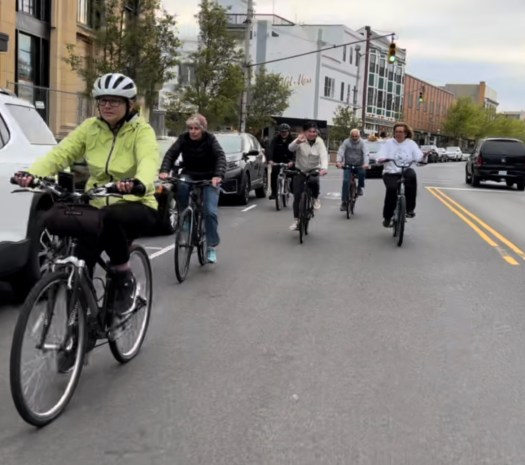
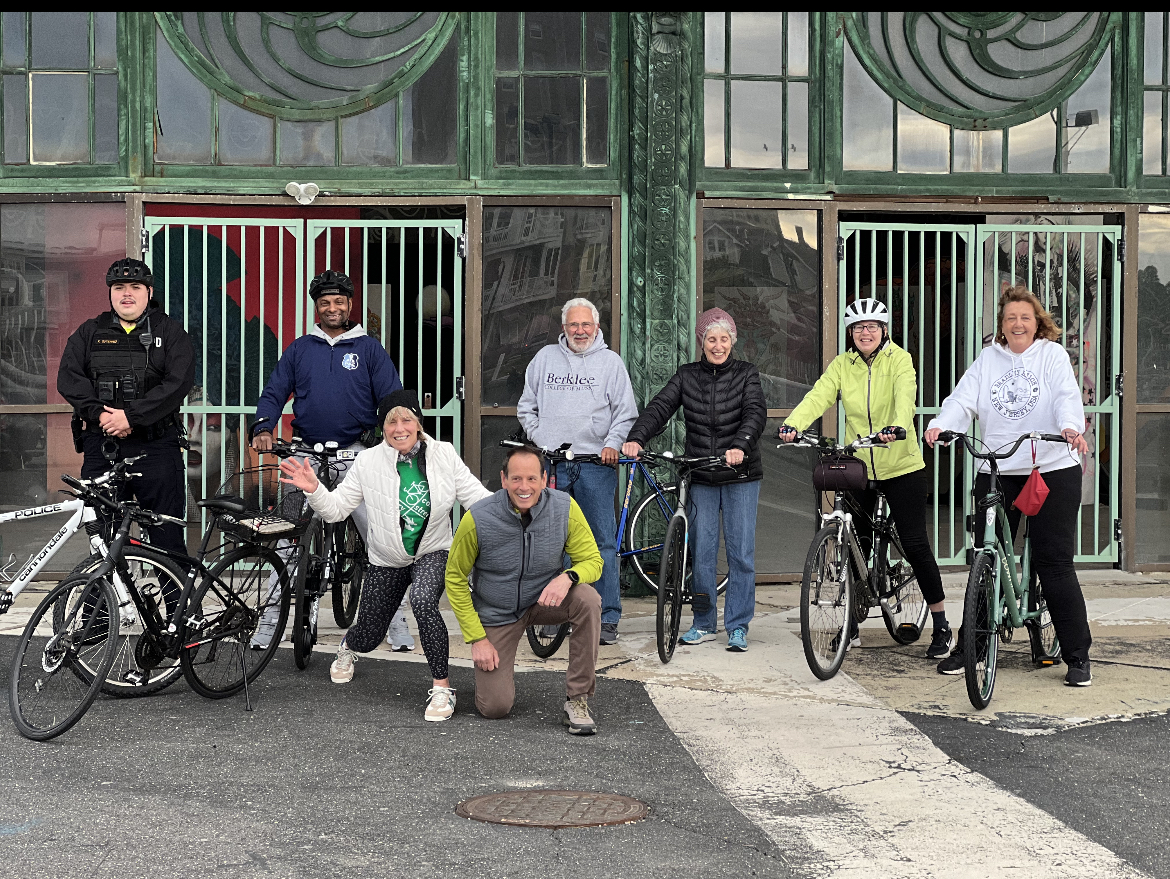
It was great to meet up with new and old friends after having to cancel the past 2 rides due to weather. Lots of good conversation on a chilly, windy evening ride around town.
More active and hyperlocal explorations (walking and biking!) make our streets more vibrant.
More vibrant streets attract increased retail, leading to greater job creation in our neighborhoods, and will help bring us together and even contribute to reducing violence in our communities.
We’re so grateful to have support from Asbury Park Police Department.
Special thanks to APPD Bike Patrol officer joining us at the back of the group!
See you in June
Email apcompletestreets@gmail.com to get on the list for updates!
Slow Roll 5.10.22 with an Asbury Park Bike Patrol officer taking up the rear!
Community bike rides enable people to explore our community in a way that’s not possible from behind a windshield of a motor vehicle.
Cruisin’ on Cookman. Hoping that the Open Street Plan will be back in effect to prioritize safety, health, and economic benefits of a people-oriented business district.
Our streets are especially dangerous for people walking or rolling. There’s an ongoing need to build more and better protected biking and walking infrastructure. We need to enable people to get around safely without dependency on cars, whether walking, riding a bike, riding a scooter, skateboard, or using a wheelchair.
What can be done right NOw?
We must design physical elements on our streets to deter speeding.
Bicyclists, scooter riders, skateboarders, elderly, children and their families are the most vulnerable road users. Asbury Park Complete Streets Coalition is committed to helping to make our streets safe for everyone to get around safely – if streets are safe for an 8-year-old or an 80-year-old, they are safe for all.
Asbury Park is the recipient of a generous grant of 500,000 from Safe Routes To School for a project utilizing roundabouts as a traffic calming method to prevent speeding.
Safe Routes to School (SRTS) safety and access improvements will provide traffic calming measures on Third Avenue and Fourth Avenue between Prospect Avenue and Comstock Street. The project Design and Construction cost is funded by federal funds administered through NJDOT Local Aid Transportation Alternatives (TA) Program and Design Assistance.
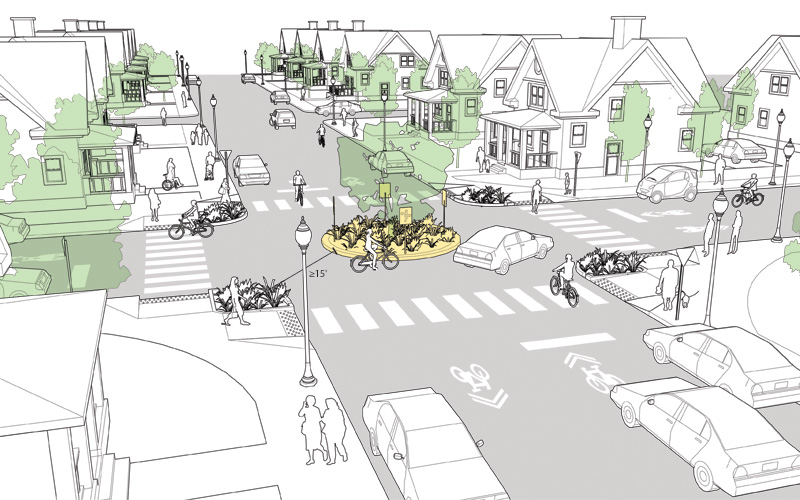
The SRTS funds are intended to install mini-roundabouts in key locations where speeding has been a serious problem.
Mini-roundabouts throughout the US are showing promising results as safety-conscious, cost-effective solutions, replacing less efficient all-way and stop-controlled intersections.
Mini-roundabouts are used where the existing speed limit is 25 mph or less and in urban, suburban and smaller municipal environments.
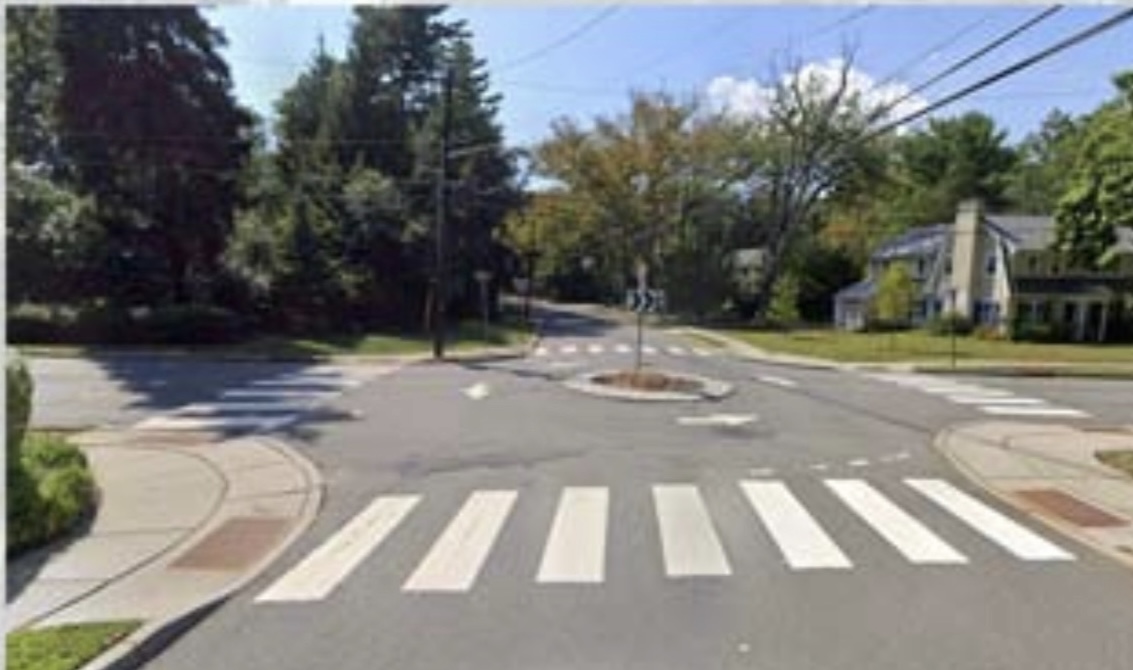
Mini-roundabout in Princeton
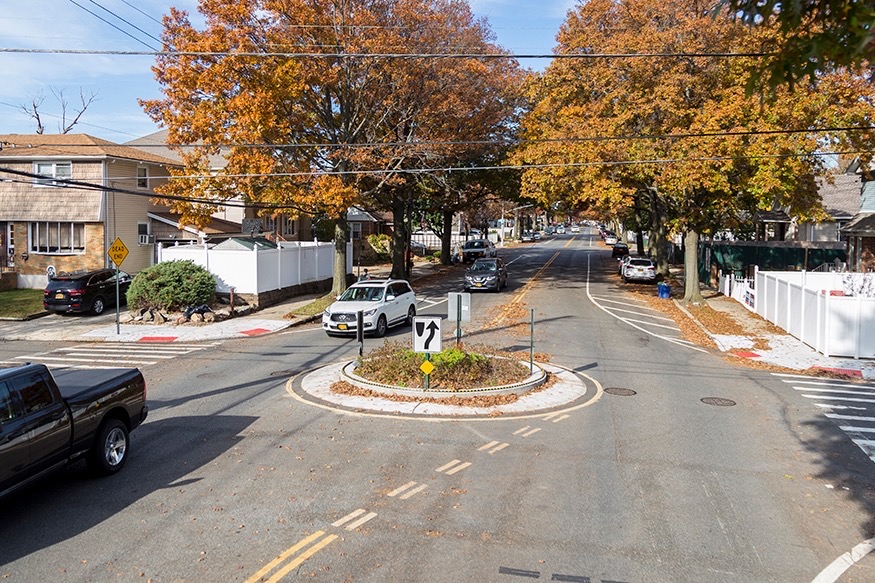
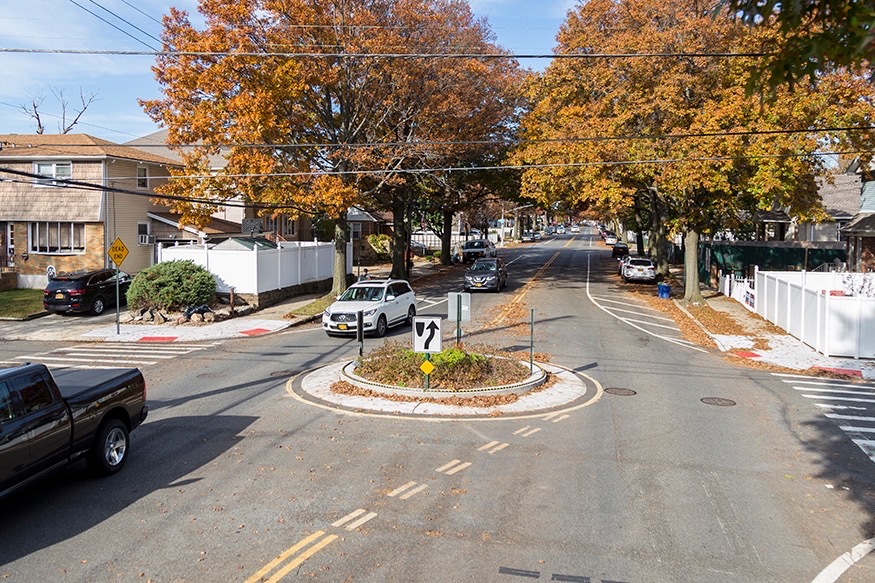
Mini-roundabout in Staten Island
Bottom line:
“Traffic calming is a full range of methods to slow cars, but not necessarily ban them, as they move through commercial and residential neighborhoods. The benefit for pedestrians and bicyclists is that cars now drive at speeds that are safer and more compatible to walking and bicycling. There is, in fact, a kind of equilibrium among all of the uses of a street, so no one mode can dominate at the expense of another.”
For a deeper dive, take a look at the USDOT Federal Highway Administration Lesson In Traffic Calming:
FHWA COURSE ON BICYCLE AND PEDESTRIAN TRANSPORTATION describes objectives, considerations, and various methods to calm traffic, such as circles and roundabouts, medians, bumps, speed humps. raised crosswalks. raised intersections, bump outs, curb extensions, and more. All of these devices are intended to #slowthecars, and are carefully determined to be applied in areas in which they will be most effective.
Share your email to APCSC mailing list/Google Group: apcpompletestreets@gmail.com.
Call and email Mayor and City Councilto offer your support for safe streets for the most vulnerable, and using traffic calming methods, especially mini-roundabouts.
We recently had a meeting in Asbury Park about the problem of speeding, and slowing drivers on our streets, a proposed traffic calming measure, specifically mini roundabouts, and how speed limits are determined.
Our Transportation Manager attempted to explain to the attendees what the 85th Percentile Rule is as they questioned why we can’t change speed limit signs. We just can’t. Or at least not without great difficulty.
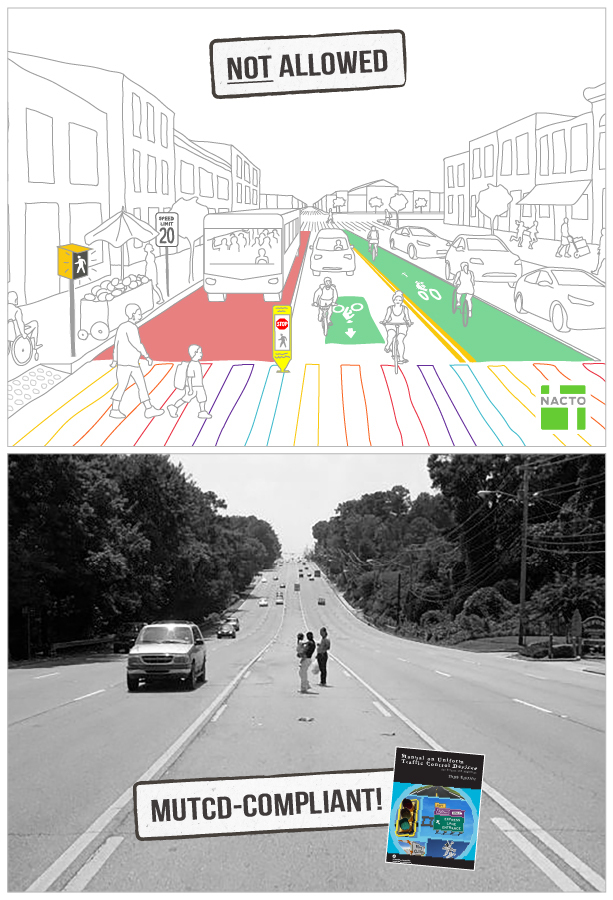
In simple terms it’s an engineering calculation that the speed limit is determined by the actual speed that people drive. It’s hopefully soon-to-be edited Manual For Urban Traffic Control Devices, MUCTD.
The 85th Percentile Rule is horrible. It’s not about safety.
Hear me? IT’S NOT ABOUT SAFETY. IT’S NOT ABOUT SLOWING DRIVERS.
It’s about expediting the movement of vehicles.
Here’s a simple, short video with great graphics with Transportation 4 America director Beth Osborne, who joined Wall Street Journal correspondent George Downs to explain why one controversial method for setting speed limits results in higher and higher speeds.
The crazy thing is that traffic engineers and planning people don’t seem to speak the same language.
We have city planners who are hamstrung by these regulations, but we can get around them with creative solutions to #slowthecars like mini-roundabouts, speed humps, street narrowing…and we have the grant money do do it.
Let’s get on the same page about saving lives and saving the planet.
People who bought huge new SUVs and trucks when prices were down are paying the price big time (as are all drivers of personal vehicles). Drivers of these oversized machines have contributed to a huge increase in road fatalities. The consumption of gas by vehicles of all sizes has contributed to deaths due to respiratory diseases resulting from the impact on the environment.
We must figure out a way, “both immediately and over the long term, to curb the addiction to oil. In the United States, transportation accounts for over 70 percent of total oil consumption, and more than 65 percent of that is for personal vehicles, according to the Energy Information Administration. Put another way, personal vehicles alone account for almost half of the burning of petroleum in America. A whopping 80 percent of U.S. climate emissions from transportation come from driving.”
The bipartisan infrastructure bill doesn’t come close to addressing the real problem, which is too many cars, which will be exacerbated by expansion of highways, rather than fixing existing infrastructure, investing in transit, and helping cities reduce car dependency. It could have funded initiatives for cities to be bold, to help to create streets that are people-centric, to make transit free, and to give rebates to people who buy bikes, and bonuses to folks who get around without a car.
“…as the National Association of City Transportation Officials (NACTO) said in a statement last year, the “bill goes in the wrong direction, giving a whopping $200 billion in virtually unrestricted funding” to unsustainable forms of transportation.”
It’s still possible for Biden to make an impact. He can publicly call upon mayors to accelerate transit development, bike, and pedestrian programs using funding in the American Rescue Plan.
“The bipartisan infrastructure package has only made the challenge more difficult. But municipalities could still make it right.”
The US is at the highest number of roadway deaths in 30 years.
We can take bold steps in our cities and design streets with traffic calming elements to slow drivers, move toward less less car dependence by providing transit, and micro mobility options. We can lobby the auto industry to stop advertising dangerous driving behaviors, and stop building larger and more murderous vehicles that can reach speeds of 160mph and beyond.
The USDOT supports Vision Zero, by preventing dangerous driving, reducing car dependency, and building more and better infrastructure to protect the most vulnerable road users.
Read the letter from the Secretary and the report.
Find out what you can do in your town to make it safe for walking, biking, and rolling in New Jersey. Join NJ Bike And Walk Coalition
Our priority at the Department of Transportation is to make our transportation system safe for all people. Right now, we face a crisis on our roadways. Almost 95 percent of our Nation’s transportation deaths occur on America’s streets, roads, and highways, and they are on the rise. An estimated 38,680 people died in motor vehicle crashes in 2020. In the first half of 2021, an estimated 20,160 people died, up 18.4 percent compared to the first six months of 2020. And every year, millions more are seriously and often permanently injured. Those lost are our family members, our friends, our colleagues, our neighbors. They are the people who build, maintain, and fix our roads. They are the people who deliver critical goods, and those who risk their own lives to keep us safe. The status quo is unacceptable, and it is preventable. We know it’s preventable because bold cities in the United States, and countries abroad, have achieved tremendous reductions in roadway deaths. We cannot accept such terrible losses here. Americans deserve to travel safely in their communities. Humans make mistakes, and as good stewards of the transportation system, we should have in place the safeguards to prevent those mistakes from being fatal. ZERO is the only acceptable number of deaths and serious injuries on our roadways.
The United States Department of Transportation National Roadway Safety Strategy (NRSS) outlines the Department’s comprehensive approach to significantly reducing serious injuries and deaths on our Nation’s highways, roads, and streets. This is the first step in working toward an ambitious long-term goal of reaching zero roadway fatalities. Safety is U.S. DOT’s top priority, and the NRSS represents a Department-wide approach to working with stakeholders across the country to achieve this goal.
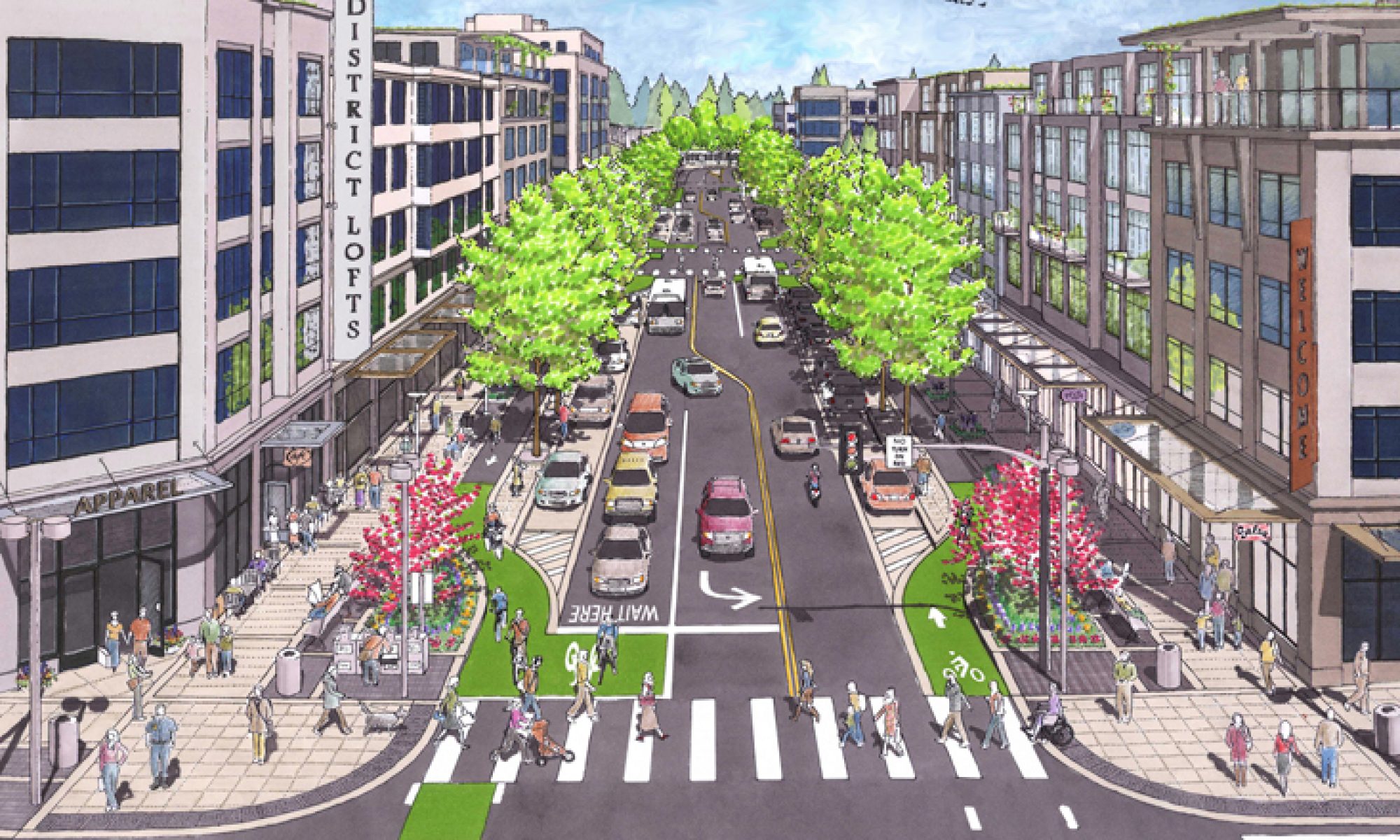
Asbury Park can redesign and reinvest in our streets as spaces for people, as well as critical arteries for traffic. 3rd and 4th Avenues are through streets into and out of our city. These are wide, lovely residential streets that are treated as speedways for drivers.
Drivers will speed if they are able to do so. Education and enforcement are certainly ways to attempt to change driver behavior. But the most effective way to prevent speeding is to erect visual and physical obstacles, so drivers are less likely to press down on the gas pedal.
One such traffic calming measure that has been discussed in Asbury Park is the use of mini roundabouts. There are other effective measures as well. Please take a look at the Urban Street Design Guide, offering the best principles and practices of the foremost engineers, planners, and designers working in cities today.
The guide outlines options that are effective and attractive to keep the most vulnerable road users safe, and to maintain the beauty of our neighborhoods.
“The N.J. Safe Passing Law comes at a critical time for making our roads safer for everyone, especially vulnerable road users,” said Jim Hunt, Safe Passing Law Campaign Leader for the New Jersey Bike & Walk Coalition. “(During the pandemic) we have seen an increase in people walking, biking and rolling to get to work, to school, or to parks or take their health and fitness routines literally on the road.”
Meanwhile vehicle traffic has increased to pre-pandemic levels on roads, he said.
“This has resulted tragically in an increase in serious injuries and deaths in the state,” Hunt said.
Advocates cited State Police records that said bicycle rider fatalities in 2021 already match last year’s total at the same date. Pedestrian fatalities now almost match 2020 and are on a pace that could lead to a 60% increase in 2021.
Passage of the bill caps over 10 years of advocacy led by the NJ Bike and Walk Coalition, Bicycle Coalition of Greater Philadelphia, Tri-State Transportation Campaign and the grassroots TEAM4 the NJ Safe Passing Law, advocates said.
THE CITY OF ASBURY PARK AWARDED $1,135,000 from NJ Department of Transportation through Bikeway Grant and Safe Streets to Transit Grant Programs.
The City will begin the Asbury Avenue Bikeway project and upgrade the intersection at Bangs and Prospect Avenues.
The Asbury Avenue Bikeway project will include upgrading the traffic signal at Asbury and Grand Avenues and bike infrastructure improvements to benefit cyclists and pedestrians.
Safe Streets to Transit projects facilitate the implementation of projects and activities that will improve pedestrian conditions within a 1-mile radius of a transit facility or station.
The grant funded by this program will be used to install a new traffic signal at Bangs and Prospect Avenues as well as to make necessary safety upgrades to the intersection.
“We’re thrilled to be awarded these NJDOT grants and look forward making much-needed improvements to Asbury Avenue and the Bangs Avenue/Prospect Avenue intersection,” said Mayor John Moor, “Funding like this allows us improve overall safety for pedestrians, cyclists and motorists in Asbury Park without burdening local taxpayers.”






 C
C