Asbury Park Slow Roll Tuesday, October 13th, 6pm!
What is a Slow Street? NJDOT Doesn’t Get It.
A Public Service Announcement: Signs – What They Mean For People Driving And On Bikes
Summer doesn’t end until September 21st, but in past Septembers the Shore towns became quiet after Labor Day Weekend. This year has been different in so many ways, in addition that visitors may be staying in towns along the Jersey Shore through the end of the month, and perhaps even longer because work and school may have been halted, delayed, or virtual.
There will be a continued, somewhat reduced volume of automobiles on the roads during Covid, but since March, even though there have been fewer vehicles miles traveled (VMT), there have been MORE fatal traffic collisions. These crashes are mostly due to excessive speeding, and partly a result of more open-feeling roads where drivers feel more entitled to run stop signs, cruise though right turns at traffic signals, and behave more aggressively toward other road users, specifically people riding bikes.
Asbury Park Complete Streets Coalition strives to educate drivers and people riding bikes to ensure that we can all stay safe. While Asbury Park is gradually implementing infrastructure to #slowthecars and make it safer for people who ride bikes, there is a lot of misunderstanding about how bicycle riders may use the roadway, where, and how.
In every jurisdiction in NJ bike riders may “use the full lane”, meaning that people on bikes have the rights and privileges of people driving. If a bike rider is causing a significant slowing of the flow of traffic, the bike rider should move to the right if practicable, and people on bikes are NOT required to give way to drivers.
Asbury Park is implementing bike lanes which so far are mostly painted outside of parked cars next to moving traffic. These lanes are useful for indicating that bike riders may be present, and they serve as traffic calming to #slowthecsars, but paint doesn’t protect. The vast amount of asphalt is still devoted to motor vehicles, leaving a narrow slice of roadway where driver side doors may swing open (the “dooring zone”), causing bicyclists serious injury or death. In places where there are no bike lanes at all, there may be grates, or debris in the shoulder, so people on bikes should ride on the roadway, ride predictably, and NOT hug the curb. Use bright bike lights, especially on the back, even during the day.
Bike lane in the “dooring zone”.
Finally, on signage:
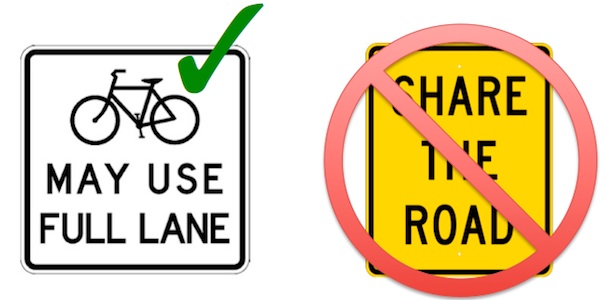
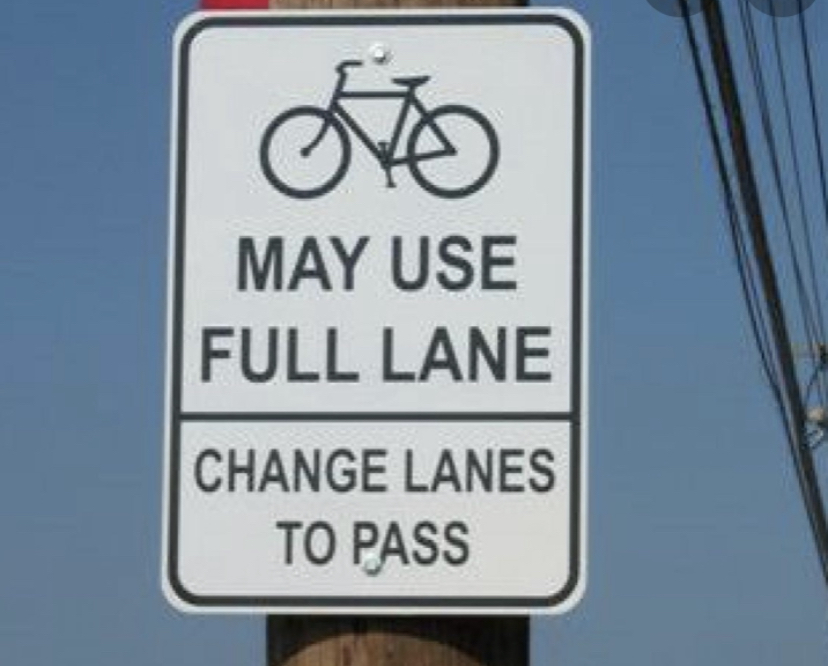
In many cities like AP, where the jurisdiction or DOT has built infrastructure and put up signage for bicycling, there’s the ubiquitous yellow “Share The Road” sign, which is intended to mean that drivers should defer to people on bikes, but it’s often read the opposite way, that people on bikes should share the road with drivers. Even more problematic, are signs in Asbury Park that state “Bike Lane Ahead” or “Bike Lane Ends”. Drivers may easily misconstrue these signs to mean that people on bikes are only permitted in these areas on the bike lanes, and not to ride on the roadway, and that they must somehow vaporize when the bike lane disappears.
No more Share The Road signs.
Misleading sign indicating that bike riders are only permitted here.
Misleading signage indicating that bike riders are not permitted beyond this point.
Let’s urge city leaders to address the need for more, and better infrastructure for people riding bikes. Help APCSC educate about bike riding. And meanwhile let’s get on our bikes and ride! There will be more driver awareness when there are more people riding bikes.
Onward!
.
It’s Time To Break Up With Cars
Americans didn’t immediately fall in love with cars. It’s been a Machiavellian relationship for a century, so maybe we can break up now.
The Car Culture That’s Helping Destroy the Planet Was By No Means Inevitable
Jeff Sparrow
On the Relentless Campaign to Force Americans to Accept the Automobile
“In 1995, comedian Denis Leary recorded a track called “Asshole,” a song about an all-American guy who likes “football and porno and books about war.” It concludes with a monologue:
I’m gonna get myself a 1967 Cadillac Eldorado convertible
Hot pink, with whale skin hubcaps
And all leather cow interior
And big brown baby seal eyes for head lights
And I’m gonna drive in that baby at 115 miles per hour
Gettin’ one mile per gallon
Sucking down Quarter Pounder cheese burgers from McDonald’s
In the old-fashioned, non-biodegradable styrofoam containers
And when I’m done sucking down those greaseball burgers
I’m gonna wipe my mouth with the American flag
And then I’m gonna toss the styrofoam containers right out the side
And there ain’t a goddamn thing anybody can do about it … “
Yes, there is. Vote.
For those concerned about the environment, cars are an ecological catastrophe, while the current president celebrates car ownership as a true hallmark of freedom for blue blooded Americans, and the US remains the “spiritual home of car culture”. Vote.
So are we doomed to live forever in a polarized country where there is a constant war for space on the road between people walking, on bikes, and driving, and over 40 thousand people die in automobile collisions each year?
Cars don’t have to own us.
Here’s something to think about as American cities (and yes, we in Asbury Park) try to figure out how to keep people safe while social distancing by opening streets to people walking, riding bikes, skateboards, scooters…there could be one good thing that comes out of Covid-19.
The spaces between parked cars can be for people, not for car domination. It’s so in cities where drivers don’t rule the roads. As one Face Book commenter in the thread notes, when he drives into one of these streets he “immediately wonders whether he should be there, then sees the benefits to everyone, and drives slowly and cautiously to his destination”. With American car culture could this happen here, or would we continue to see angry, entitled drivers claiming their right to the road, endangering us all?
Here’s the link to Modacitylife FaceBook page, where you can enjoy beautiful city inspiration, listen to the audio book, Building The Cycling City, and buy the book here.
Bike and Pedestrian Infrastructure – The Best Investment
A GRAPHIC FROM OUR FRIENDS AT
WEST WINDSOR BICYCLE AND PEDESTRIAN ALLIANCE
In this time of massive unemployment and government spending, it’s great to know that building bicycle and pedestrian infrastructure creates more jobs than other infrastructure spending (because it’s less automated).
Perhaps more importantly, creating a safe way to bike and walk places improves health, reduces pollution and improves the local economy, since people who bike and walk to shopping buy more frequently.
There’s no better investment.
UK Wants To Ban American SUVs and Trucks As Too Dangerous
Drivers in the US are attracted to huge SUVs and trucks party because fuel prices are so low, and mostly as a result of the brainwashing effect of the automotive industry advertising the feeling of personal empowerment and freedom. The industry has slowed or stopped production of less-profitable sedans and focused on bigger vehicles with higher margins, so they sell the truck drug to willing consumers. This article from 2005 from The University of Rochester describes ads for SUVs and trucks triggering an emotional response with the promise of liberation and freedom. The names of vehicles like Ford’s Discovery and Freelander, Subaru’s Forester and Outback, Ford’s Excursion, Expedition and Escape evoke the All-American love of wilderness and exploration. The names of these giant vehicles conjure up the great American outdoors, while disregarding the negative environmental impact, as described in 2006 in this article from The University of Colorado Center Science and Policy.
The SUV Durango Hellcat is marketed in this ad, driving on a completely empty road in the middle of nowhere, as a “family” SUV (a family vehicle named Hellcat??), with top speed of 180 mph and 0-60 in 3.5 seconds. The reality is that these are death vehicles operating in our cities and suburbs.
Tall front grills will more likely kill a pedestrian by striking at chest level, or crushing an unseen child, than a sedan, which would strike at leg level.
“Landmark studies from the Insurance Institute for Highway Safety, the Governor’s Highway Safety Association, and others have correlated a 50-percent increase in U.S. pedestrian fatalities over eight years to the rising popularity of pick-ups, vans, and sport utility vehicles.”
As a result of these statistics, citing “U.S. vehicle safety standards are much lower than those permitted for vehicles sold in the U.K.”, experts in the United Kingdom are urging their government to ban import of American-made SUVs.
The UK is considering banning American SUVs and Trucks deeming them too dangerous,. Will the US follow suit and eliminate them from American streets? Doubt it.
American SUVs are Too Dangerous for UK Roads, UK Safety Experts Say
New cars in the United Kingdom are required to meet advanced vehicle safety standards that mandate pedestrian detection technology, and, eventually, speed limiters. Meanwhile, U.S. vehicle safety standards only require car manufacturers to meet minimum crash safety standards for people inside vehicles in the event of a collision — and say nothing about vulnerable road users who might be on the other end of a crash.
Do It In The Road: Asbury Park ReOPEN and Slow Streets Pilots
Everyone deserves to have safe streets to access work, businesses, and recreation, especially now when we need more space to move about our cities with appropriate social distance without risk of vehicular traffic.
Asbury Park ReOPEN, a pilot which currently runs Thursdays through Monday mornings, is helping businesses to generate revenue with restriction of capacity, mask requirements, distancing, and limited hours. Separately, “Slow Streets” will be set up on various streets in the city, where vehicular traffic will be limited to local only, allowing residents to move about safely on the street playing, bicycling, walking, and rolling without risk from cars and trucks.
Many cities across the US and the world have implemented these measures, including in CA, TX, KY, OH, MA, and many more. Jersey City’s Slow Streets pilot program is 24/7, described here:
Due to the Covid-19 safety measures, the City of Jersey City is working to provide residents additional open space that supports safe physical activity by designating certain streets throughout the City as “Slow Streets”. These streets will be closed to through traffic so that people can more comfortably use them for physically distant walking, wheelchair rolling, jogging, biking and exercising all across the City.
Enjoy the following blog post and photos from a visitor to Asbury Park’s Business District.
Stay tuned for continued adaptations to the program in neighborhoods all over the city, and upcoming implementation and photos from Slow Streets in Asbury Park. We welcome your thoughts and constructive comments.
WESTWORDS
TUESDAY, JULY 21, 2020
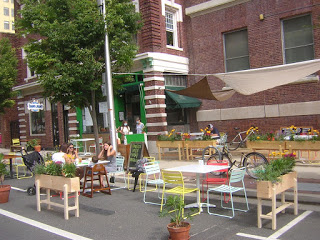
A “Streaterie”, in this case resembling a Parklet
Businesses selling wares on the street.
The Book Co-Op set up on the sidewalk for passersby to browse.
Change Policing Of Our Cities, Starting With Traffic Enforcement
Asbury Park Complete Streets Coalition supports a reallocation of police resources, specifically of traffic enforcement, and also in calls involving mental illness, homelessness, and other non-criminal issues where other professionals can be of much more effective service. Since the early 1920’s the often violent consequences of policing traffic has been borne mostly by people of color. You’ll read below how our roads have become over policed, and how Berkeley, California is “de-copping” traffic enforcement.
To fully understand the history of the policing of American roads, take a listen to this great War On Cars Podcast:
The Automotive Police State
The podcast introduction:
“For a century, the automobile has been sold to Americans as the ultimate freedom machine. In her groundbreaking new book, “Policing the Open Road,” historian and legal scholar Sarah Seo explodes that myth. Seo shows how modern policing evolved in lockstep with the development of the car. And that rather than giving Americans greater freedom, the massive body of traffic law required to facilitate mass motoring helped to establish a kind of automotive police state. Is a car a private, personal space deserving Fourth Amendment protection from “unreasonable searches and seizures?” Or is a car something else entirely? It’s a question that courts have struggled with for decades, ultimately leaving it up to the police to use their own discretion, often with horrifying results, especially for minorities. In this revelatory conversation with TWOC co-host Aaron Naparstek, Seo offers an entirely new way of looking at the impact of the automobile on American life, law and culture.”
Read the excerpt in The Boston Review, Policing the Open Road: How Cars Transformed American Freedom by Sarah A. Seo:
How Cars Transformed Policing
“The overpolicing of cars is a fact of life for people of color in the United States.”
“In their book In Context: Understanding Police Killings of Unarmed Citizens, scholars Nick Selby, Ben Singleton, and Ed Flosi concluded, “No form of direct government control comes close to [traffic] stops in sheer numbers, frequency, proportion of the population affected, and in many instances, the degree of coercive intrusion.”
To learn about Berkeley, CA becoming the “first in the United States to take police officers out of traffic enforcement, read this Streetsblog USA article:
Berkeley To Become the First US City To De-Cop Traffic Enforcement
“Racism in street safety law enforcement, of course, is not unique to Berkeley — and some street safety advocates hope that their own cities will consider similar proposals.”
Click here to read more.
A City Without Cars – Could Asbury Park Do It?
This NYTIMES article, filled with great graphics and data has evoked many responses from readers, and inspired other opinion pieces like this from StreetsBlog.
What are your thoughts about minimizing or eliminating automobiles in Asbury Park? How do you envision our city in 2 years, 5 years, or 10? We know that real estate has been strong, even during the pandemic, and gradually we will see more condos built on iStar’s lots, meaning more people, and undoubtedly more cars, unless we start now to mitigate car use and parking availability. Within the past couple of weeks traffic we’ve seen traffic escalate back to pre pandemic congestion in the business district and waterfront. Drivers are speeding in every neighborhood in the city.
APCSC believes in a walkable, bikeable, livable Asbury Park where everyone, especially the most vulnerable can access every part of the city without the dangers associated with motor vehicles.
Read on…
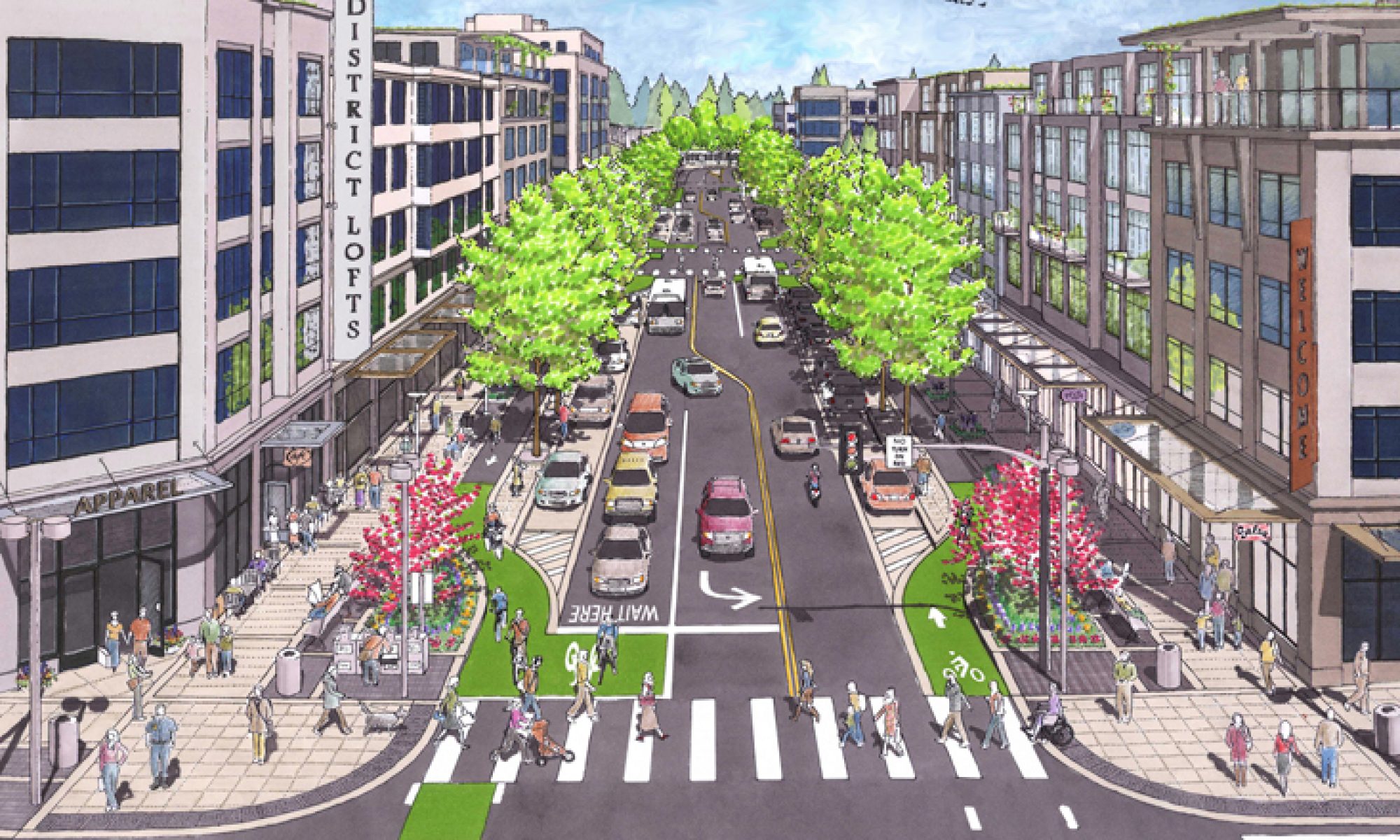
I’ve Seen a Future Without Cars, and It’s Amazing
Why do American cities waste so much space on cars?
“Automobiles are not just dangerous and bad for the environment; they are also profoundly wasteful of the land around us, taking up way too much physical space to transport too few people. It’s geometry.
In most American cities, wherever you look, you will see a landscape constructed primarily for the movement and storage of automobiles, not for the enjoyment of people: endless wide boulevards and freeways for cars to move swiftly; each road lined with parking spaces for cars at rest; retail establishments ringed with spots for cars…”
What does it take to move 50 people?
50 cars: 55 square feet per person.
One bus: 9 square feet per person
50 bicycles: 15 square feet per person
Read it here:


Asbury Park Complete Streets Coalition founding member, Polli Schildge standing in the left turn lane on Asbury Park’s Main Street road diet!