APCSC to Win Award and Host Session at Summit

ASBURY PARK

NJ BIKE & WALK COALITION NAMES APCSC LOCAL ADVOCATE OF YEAR

Michelle Gladden

AP COMPLETE STREETS COALITION WILL ADMINISTERS SATURDAY PANEL ON GROWING JERSEY SHORE NETWORK

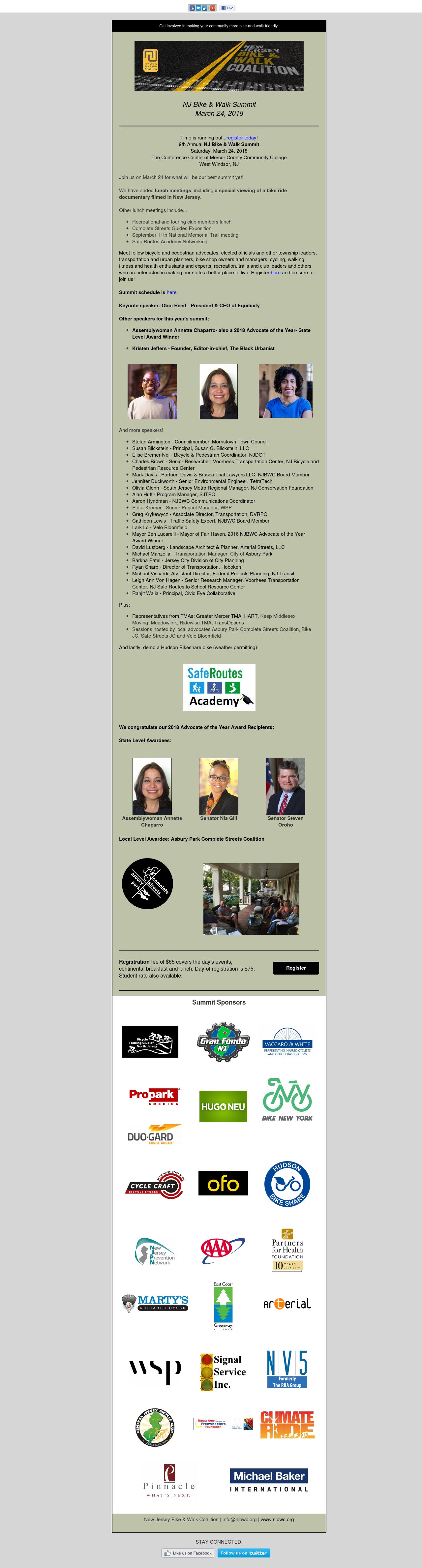
The Asbury Park Complete Streets Coalition will be participating in the New Jersey Bike & Walk Summit on Saturday, March 24th at Mercer County Community College in West Windsor, NJ.  The Summit is organized annually by the New Jersey Bike & Walk Coalition.  Details about the Summit can be found at http://njbwc.org/summit-2018/ .

The keynote speaker at this year’s Summit will be Oboi Reed, an urbanist and advocate for equitable streets in minority and traditionally underserved neighborhoods.  Mr. Reed’s talk about community equity should be very relevant to Asbury Park.

The Asbury Park Complete Streets Coalition will be receiving an award for advocacy and we will be expressing our appreciation to our mayor and council for helping Asbury Park evolve into a statewide leader for safe, inclusive and accessible streets.

We will also be hosting a session about expanding Complete Streets principles in the Jersey Shore area titled “Jersey Shore Complete Streets Workshop.” The goal of our workshop session is to think about improvements to our pedestrian, bike and transit networks beyond our municipal borders is the Jersey shore region.


r

Read more…

http://asburyparksun.com/ap-complete-streets-coalition-receives-second-state-honor/

Diversity in Bicycling

10 REASONS BICYCLING WILL CONTINUE TO SOAR IN POPULARITY

 
BY JAY WALLJASPER

For too long biking has been viewed skeptically as a white-people thing, a big city thing, an ultra-fit athlete thing, a twenty-something thing, a warm weather thing or an upper-middle class thing. And above all else, it’s seen as a guy thing.

But guess what? The times they are a changing. More than 100 million Americans rode a bike in 2014, and bicycles have out-sold cars most years in the US since 2003. A couple other facts that may surprise you:

  • Latinos bike more than any other racial group, followed by Asians and Native Americans. African-Americans and Caucasians bike at about the same rate.
  • Most bicyclists are low-income according to census figures — as many as 49 percent of bike commuters make less than $25,000 a year.


OLYMPUS DIGITAL CAMERA
Read more…

https://www.strongtowns.org/journal/2018/2/9/12-reasons-bicycling-will-continue-to-soar-in-popularity

A Non-Cyclist’s Case For Bike Lanes

I DON’T BIKE, BUT I STILL FEEL SAFER ON STREETS WITH BIKE LANES. THIS ESSAY EXPLAINS WHY.
  Michael Lewyn | March 11, 2018

I never learned to ride a bicycle. And yet I am an active member of an organization dominated by bicycle riders, and is often focused on increasing the number of urban bike lanes. Why?

Because I believe that walkers benefit from bike lanes as well. Here’s why: when a traffic lane is devoted to bicycles and taken away from cars, this means that the remaining lanes are either narrower or there are fewer of them. As a matter of common sense, it seems obvious that motorists drive more slowly on narrower streets. And when motorists drive more slowly, they are less dangerous to walkers or to each other.

Read more…

https://www.planetizen.com/node/97632?utm_source=newswire&utm_medium=email&utm_campaign=news-03152018&mc_cid=0e22636014&mc_eid=b71ae7bff7

Access for People with Disabilities

The partnerships enabling disabled city residents to better explore their surroundings

March 15, 2018

As cities work to add technologies to improve residents’ lives and mobility, many are putting a renewed focus on inclusivity and equitable innovation distribution. Yet despite this inclusivity push, experts say people with disabilities remain an overlooked group, especially during city planning processes.

Read more…

https://www.smartcitiesdive.com/news/the-partnerships-enabling-disabled-city-residents-to-better-explore-their-s/519029/

Asbury Park Road Diet

Main Street in Asbury Park gets $19 million makeover

Austin Bogues March 20, 2018 

“The goal of the road diet is to decrease travel time through the Main Street corridor and create a safer, more efficient traffic flow. This will help with pedestrian and bicycle safety and improving emergency services response time…”

Read more…

https://www.app.com/story/news/local/communitychange/2018/03/20/main-street-asbury-park-gets-19-million-makeover/437608002/

The Atlantic: Bike Lane Design Bible

The Design Bible That Changed How Americans Bike in Cities

A movement has brought safer bicycle lanes to the United States. But it took a manual to spread them.

STEVEN HIGASHIDE  MAR 1, 2018

How did the protected bike lane suddenly become common in America? Advocates will tell you it was the result of stalwart activism. And trailblazing, politically daring transportation officials did play a part in bringing better bike lanes to the nation. But the spread of bike lanes to so many corners of the country couldn’t have happened without a simple, ordinary technology: a set of street-design standards, written down in a book so that less daring engineers didn’t have to blaze their own trails anew.

https://www.theatlantic.com/technology/archive/2018/03/a-new-bible-for-bike-lanes/554450/

PARKING PROBLEMS?

Asbury Park isn’t alone.  Parking issues are common and not insurmountable.  Learn about parking minimums here.

 
BY RACHEL QUEDNAU

When a local government proposes removing or decreasing parking minimums, communities tend to freak out a little bit. 

Business owners show up at public meetings concerned that their customers will have nowhere to park. Homeowners write angry letters, worried that their quiet residential streets are going to fill with spillover parking.

Read more…

https://www.strongtowns.org/journal/2018/3/13/the-parking-problem-that-wasnt

The Case Against Jaywalking Laws

Thankfully there is not over enforcement of jaywalking in Asbury Park, but on social media we’ve often heard complaints about jaywalkers on Main Street and elsewhere in the city.

This article is one of many explaining how the term “jaywalking” originated, and the problem that has resulted from our nation’s streets belonging to cars rather than people, and the targeting of people of color (mostly black men) for a trivial infraction that almost everyone has committed numerous times in their lives.  These stories are harrowing and all-too familiar.

Asbury Park and APCSC are working on keeping pedestrians safe by developing better infrastructure and by slowing cars with traffic calming methods, not by criminalizing people walking outside painted lines.

Jaywalking laws are enforced disproportionately against black Americans, sometimes with fatal results.


“What sets jaywalking apart is that it never should have been against the law in the first place. City streets were meant for foot traffic and horses from ancient times until the early twentieth century. As a result, early automobiles found themselves alongside all sorts of pedestrians. To make way for cars, literally and figuratively, wealthy drivers and the U.S. auto industry set out to stigmatize lower-class pedestrians who crossed streets at will. Those who wouldn’t step aside for vehicles became known as “jay walkers…”

Read more…

https://newrepublic.com/article/147396/case-jaywalking-laws

Bike Helmets Keep Bicyclists Safe? Think Again.

AMERICAN CITIES’ PREOCCUPATION WITH HELMETS MIGHT UNDERMINE MORE EFFECTIVE WAYS TO PROTECT CYCLISTS.

THE UNHELPFUL WAYS CITIES TALK ABOUT BIKE HELMETS

CITYLAB

Former Denver Mayor John Hickenlooper (center) wore a helmet for the unveiling of the city’s Bcycle bike-share system. But do any of its users? Ed Andrieski/AP

By contrast, other cities depict cyclists of various races and genders in street clothes, some wearing helmets and others not. Culver cites the following promotional image from Minneapolis as a positive example of cyclist representation.

https://www.citylab.com/transportation/2018/03/why-cities-should-watch-their-words-on-bike-safety/554600/

Complete Communities Prioritize Pedestrians

In complete communities, pedestrians take precedence


Part of the appeal of downtown Toronto is that it represents our most mature “complete community,” defined in the city’s official plan as places where it is possible to live, work and enjoy daily life within walking distance or a short transit ride from home.  (RAFFI ANDERIAN ILLUSTRATION)
Part of the appeal of any downtown is walkability, and easy access to local transportation, and “last mile transit” from public transportation to destinations within the city.
Read more…

https://www.thestar.com/opinion/commentary/2014/08/16/in_complete_communities_pedestrians_take_precedence.html