Cool Visualization of Parking Spaces

See Just How Much Of A City’s Land Is Used For Parking Spaces

BY ADELE PETERS  

Get a look at how much space is allotted to parking in cities around the world.

“At the moment, cars spend around 95% of the time parked, and only 5% of the time in use. Huge swaths of cities, either in parking lots, garages, or street parking spaces, are used as storage for cars (while, at the same time, many cities struggle to find enough land to build housing to keep up with demand). “There’s this huge space that’s basically wasted,” says Szell.”

“The visualization is part of a project called What the Street? that inventories parking lots in 23 cities around the world, along with the space used for roads, rail lines and rail yards, and bike paths and bike parking. ”

Read more…

https://www.fastcompany.com/40441392/see-just-how-much-of-a-citys-land-is-used-for-parking-spaces

What’s a Pedestrian Scramble? Video:Japan’s Shibuya Crossing

Watch this amazing video and read about how pedestrians and bicyclists can cross the street safely while all vehicular traffic is stopped at streets in all directions in the intersection.  Prioritizing people over vehicles in a very big way!

Pedestrian scramble

 Shibuya Crosswalk, Japan

Watch:

https://www.youtube.com/watch?v=Od6EeCWytZo

pedestrian scramble, also known as scramble intersection (Canada), ‘X’ Crossing (UK), diagonal crossing (US), exclusive pedestrian interval, or Barnes Dance, is a type of traffic signal movement that temporarily stops all vehicular traffic, thereby allowing pedestrians to cross an intersection in every direction, including diagonally, at the same time.

It was first used in Canada and the United States in the late 1940s, but it later fell out of favor with traffic engineers there, as it was seen as prioritizing flow of pedestrians over flow of car traffic. Its benefits for pedestrian amenity and safety have led to new examples being installed in many countries in recent years.

Read more…

https://en.wikipedia.org/wiki/Pedestrian_scramble


https://www.youtube.com/watch?v=Od6EeCWytZo

Mobility and Potential Exposure to Diversity

Travelling together alone and alone together: mobility and potential exposure to diversity

Pages 1-15 | Received 02 Jan 2017, Accepted 13 Jan 2017, Published online: 02 Mar 2017

Quantity and quality of social relations correlate with our happiness and physical health. Our (feeling of) connectedness also matters for the efficacy and functioning of communities and societies as a whole. Different mobility practices offer different conditions for being exposed to other people and the environment.

Excerpt:

“Travelling by car, using public transport, walking and cycling seem to offer radically different levels of interaction potential, especially with people outside one’s own social network and with the physical environment. This exposure potentially affects the level to which we feel connected to a certain place and society. ”

Photo 2018, Community bike ride in Asbury Park

Read more…

https://www.tandfonline.com/doi/full/10.1080/23800127.2017.1283122

Thanks to Cycling Professor @fietsprofessor

Thanks to Urban Cycling Institute: urbancyclinginstitute.com

Building for Tourism vs Livability?

This article is from Strong Towns archives of most popular. Sound a bit familiar?  Asbury Park, having been “economically down on its luck but working toward a better future.”

THE BIG URBAN MISTAKE: BUILDING FOR TOURISM VS. LIVABILITY

 
BY ARIAN HORBOVETZ

“Originally posted on Strong Towns member Arian Horbovetz’s blog, The Urban Phoenix, and republished on our site in May, I have heard many people talk about how this essay voiced what they’d been feeling about their own communities, or helped them look at their towns in a new light. Arian writes primarily about issues facing small to mid-sized cities in New York state, but the topics he addresses apply to so many Rust Belt communities and truly, to any town that’s economically down on its luck but working towards a better future.” – Rachel Quednau

Read more…

https://www.strongtowns.org/journal/2017/12/5/the-big-urban-mistake-building-for-tourism-vs-livability


PBS: Grant Money For Bike Lanes Dries Up for Blue States

Infrastructure in rural areas are sorely in need of repairs and upgrades.  But what does it mean for cities in blue states?  “Of the 41 grants announced by the Trump administration, 25 totaling $271 million were awarded to projects in congressional districts represented by Republicans. Districts represented by Democrats garnered 14 projects and $190 million.”

Under Trump, new transportation grants ditch bikes, walkways


A woman rides a bicycle along a designated bike lane on Queens Boulevard in the borough of Queens in New York, U.S., May 5, 2016. REUTERS/Shannon Stapleton – S1BETDQANDAB

WASHINGTON — Forget about bike-share stations in Chicago or pedestrian walkways in Oakland.

In the Trump administration, a popular $500 million transportation grant program is focused more on projects in rural areas that turned out for Donald Trump in the 2016 election. That means more road and rail projects in GOP strongholds such as Idaho, North Dakota, and Oklahoma, and fewer “greenways,” ”complete streets” and bike lanes.

The latest round of these grants has nothing for New York City, Los Angeles or Chicago. Money in those Democratic heavy states went instead to projects in Trump-friendly regions: repainting a bridge in New York’s North Country, contributing to a highway project in Modesto, California, and upgrading an interstate highway in southern Illinois.

Read more..

https://www.pbs.org/newshour/nation/under-trump-new-transportation-grants-ditch-bikes-walkways

A Badass Bike With A Handicap Decal

This is advocacy!

Staying out of the wheelchair and getting on a badass bike!

Chris Billman is the only Oregonian with a disabled parking decal for his bicycle

Jonathan Maus (Publisher/Editor), Feb. 18, 2018

“Billman has the passion and persistence that are hallmarks of an effective advocate. And there are a lot of other things he’d like to change (like making bikeways fall under ADA regulations for quality and accessiblity). It’s all about accessibility and staying independent as long as possible.

“TriMet spends millions of dollars to send a little bus out to your house [referring to their Lift service], as long as you get in the wheelchair. But to me, it’s about staying out of the wheelchair. I don’t want to get into one! That’s not transportation — that’s keeping people more-or-less captive,” he shared with me in a phone cal. last week. “I’m a 61-year-old man who’s been independent all my life and now I have to call up someone 48 hours in advance to take me into town? Screw you! I don’t want it! We bought a badass bicycle, we decked it out, we’ve got a 50-amp motor and plenty of solar power… We can go anywhere.”

Read more…

https://bikeportland.org/2018/02/19/chris-billman-is-the-only-oregonian-with-a-disabled-parking-decal-for-his-bicycle-268675


Very cool science: Bike lanes experiment…

measures cyclist response to infrastructure design.

Penn Today, Office of University of Pennsylvania

Brandon BakerWriter

Asbury Park is getting set to install bike lanes.  Here is some science to consider.

“A professor and students use goggles to test bikers’ riding behavior while traveling on Philadelphia’s bike lanes. Here, a snapshot of how Megan Ryerson is using data and technology to plan safer streets, and marry design and public health.”

We don’t need to turn Philly into Denmark, but we can feel safe biking to school.

“Healthy environments as a design principle, she says, is the idea that creating a safer intersection promotes a “spiral” of completely improving a neighborhood. People feel safe, so they feel good about their neighborhoods, and, therefore, they do good: They clean up streets, start neighborhood groups, and maybe advocate for a new speed bump on their street. From a public health standpoint, this encourages low-mobility neighbors—particularly the elderly, who Ryerson says can be discouraged by design details as seemingly minor as a traffic light that turns over too quickly—to spend more time outside.”

Read more…

https://penntoday.upenn.edu/news/bike-lanes-experiment-measures-cyclist-response-infrastructure-design

Streetfilms: Hoboken Prioritizes People Over Parking!

Asbury Park has some issues in common with Hoboken. Let’s make this something great that we can have in common!

Check out this beautiful video showing ways that the city of Hoboken has reduced parking to allow for better visibility for pedestrians and bicyclists to safely cross streets.

“Last week, I happened to be on the other side of the Hudson, cruising the New Jersey waterfront on a Citi Bike, going up from Jersey City to Hoboken and Weehawken, then back.

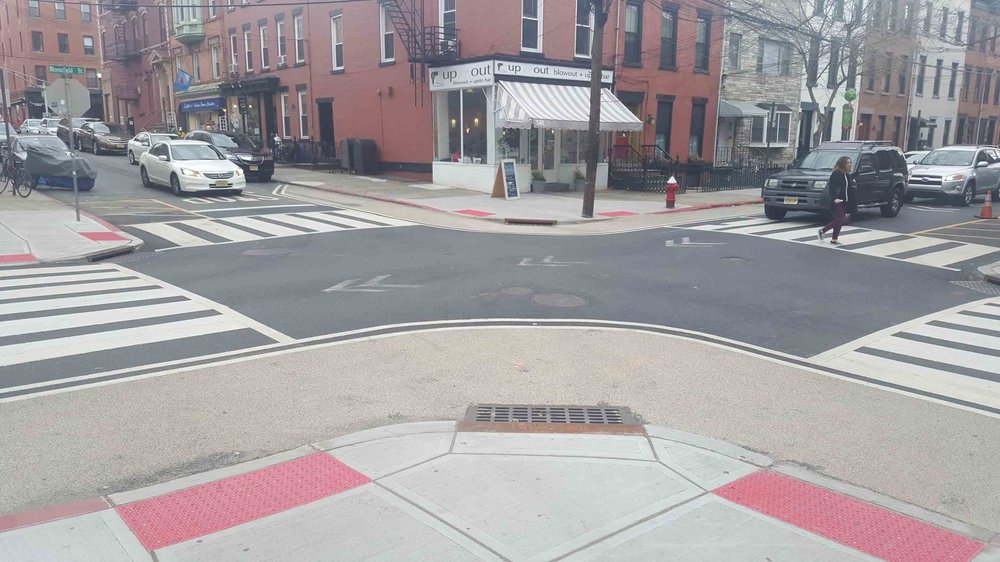
On the return leg of my trip, I just couldn’t believe how comfortable the streets of Hoboken felt as I was biking and walking. One thing stuck out to me: Nearly every intersection has “daylighting,” meaning the space approaching the crosswalks is kept clear of cars, so everyone at intersections is more visible to each other. At several intersections in Hoboken, every corner is daylit.

I didn’t plan to make a video about daylighting in Hoboken or schedule interviews with city officials. But I had my camera, thinking I could get some nice NYC skyline shots (nope, overcast), and I’m glad I did. I started taping and put together these observations, which I think will be valuable in New York and elsewhere.

Daylighting is a strategy that advocates are well aware of, but city governments hesitate to do it if it means repurposing parking spaces. Even in New York, where most people don’t own cars, at a typical intersection drivers are allowed to park right up to the crosswalk, limiting visibility to the detriment of public safety.

Hoboken is showing what a city can do when it prizes safety for everyone above free car storage for a few. It should be the default practice everywhere.

For bonus footage from Hoboken, check out the awesome Observer Highway protected bike lane — one of the best green lanes I’ve seen in an American city!”

Watch:

https://player.vimeo.com/video/262540737