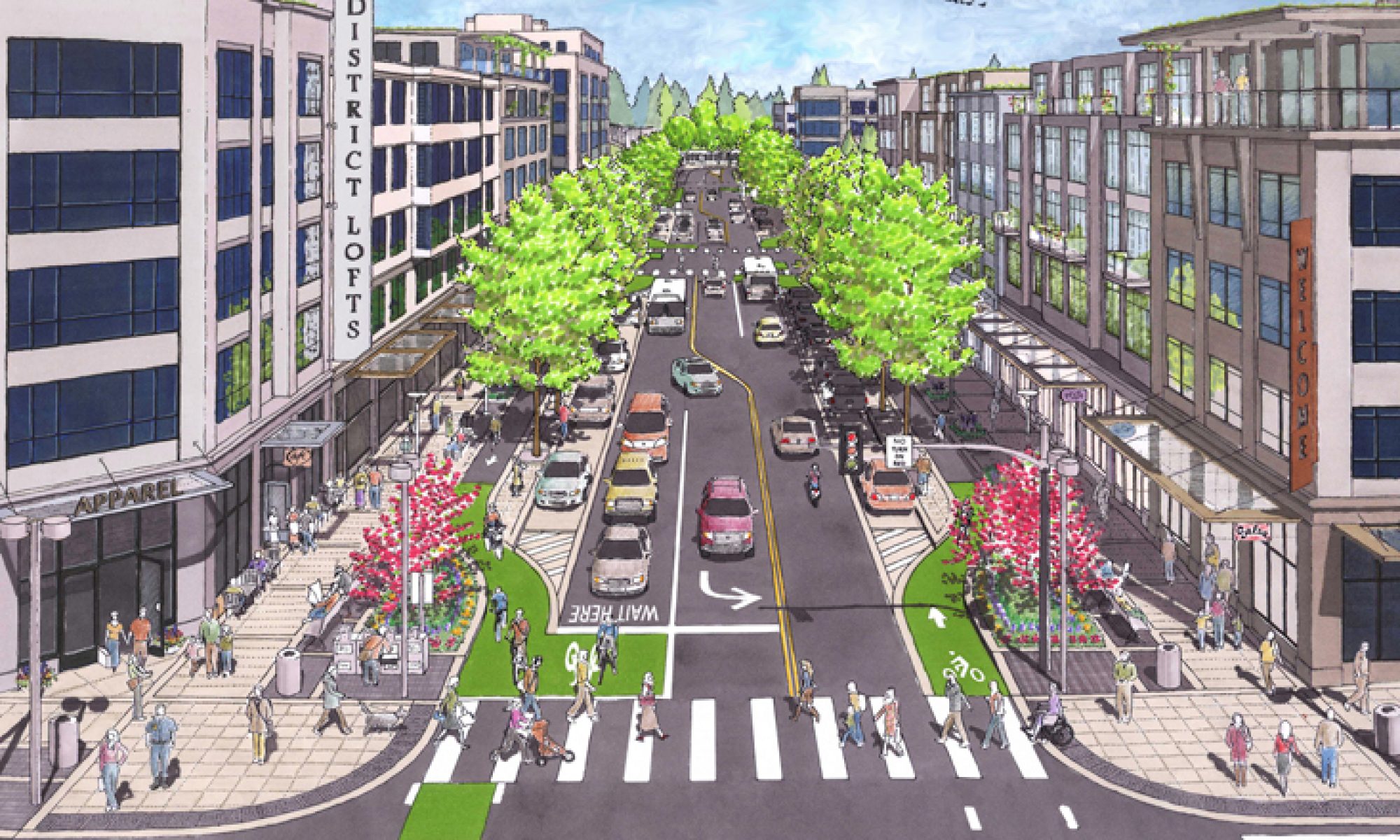
It’s a critical time to address how bicycling and biking infrastructure impact People Of Color in Asbury Park. Everyone deserves safe access through neighborhoods, and many people in the city ride bikes and walk as their main ways of getting around. So while we need to continue to create safe ways for people to move about the city, we also need to address the fear that the correlation of bike lanes and gentrification will lead to displacement . The city is currently following the Plan for Walking and Biking, created in 2018, gradually adding bike lanes, sidewalks, and intersection bump outs, and it is critical that we engage now and listen to how this infrastructure affects People Of Color in our city, and seek to mitigate negative impacts.
Girl cycles behind people on the street in San Francisco, California. Locals ride the closed streets once a month on a Sunday., Image: 98680003, License: Rights-managed, Restrictions: , Model Release: no, Credit line: Adam Gasson / Alamy / Profimedia
While we continue to advocate for biking, and we’re putting in bicycle lanes and other infrastructure to make Asbury Park a more vibrant and livable city, we may have also played an unwitting role in the gentrification of our city. Listen to the excellent interview with Stehlin here.
Asbury Park Complete streets Coalition advocates for a city that provides equitable access for everyone, especially the most vulnerable.
This webinar (see the video below) addresses:
the overall benefits of creating places that are equitable, walkable and transit-oriented
how zoning and other policy interventions affect the form, development and diversity of the built environment
creative ways for providing and sustaining transit services in diverse communities
first- and last-mile access to public transportation
opportunity zones and the funding and financing opportunities that are available for equitable development projects and activities through public and private programs and partnerships
how to build political will for equitable transit-oriented development
Equitable Transit-Oriented Development
Watch a video webinar presented by Smart Growth America
An illustration shows that equality is giving the same bicycle to each person. Equity is giving each person a bicycle that’s suitable to their size and ability.
“When we think about community development, transportation investments, as well as community engagement, too often the conversation is around how we take one specific policy and apply it to all communities and diverse populations,” Christopher Coes explains in this training webinar, hosted by AARP Livable Communities.
That is done, he adds, “without truly understanding how those populations, whether vulnerable or senior citizens, have their own unique challenges and require specific resources for them to be successful.”
In the equity space, land use decisions and transportation investments need to, Coes notes, “be applicable to all citizens where they are.”
We have much to learn as we work to create a city for people, by taking antiracist action in the built environment. We must:
Acknowledge that equity is a matter of life and death — not an “add-on”.
Center Black communities in transportation planning.
Honor Black anger.
‘Centering Equity is a Matter of Life and Death’: Responding to Anti-Black Racism in Urbanism
Five visionary leaders shared their wisdom on how to take antiracist action in the built environment professions. Here are a few of the highlights for Streetsblog readers.
By Kea WilsonThe event followed a CUI panel earlier this month that attracted more than 2,000 live viewers and went viral on Twitter. (Streetsblog Chicago’s Courtney Cobbs recapped it here.) The response was so resounding that the Institute brought back the panelists for a follow-up — with an emphasis on helping practitioners take meaningful antiracist action.1. Equity is a matter of life and death — not an “add-on”Many street-safety movements historically have focused so heavily on the dangers of car traffic that they’ve failed to recognize other major safety threats — such as racialized violence against Black people — as barriers to the safe use of public space. Jay Pitter, CUI senior fellow, underscored this failure elegantly when she reminded viewers of how such supposedly “neutral” urban-planning policies as land use zoning, transportation planning and architecture have been used to oppress, brutalize, kill, and destroy intergenerational wealth among BIPOC communities.
“Centering equity isn’t just a nice thing to do. It’s a matter of life and death,” Pitter said. “None of us [in the built environment professions] have clean hands. We are not working in a pure profession. What we need to do now is work actively to mitigate gaps.”
When it comes to mobility, advocates stress that real justice starts with the simple recognition that centering equity is integral to street safety — and not, as some Vision Zero chapters have claimed, an optional sixth “E” in Vision Zero’s “five E’s” framework for achieving zero roadway deaths. (The other 5 E’s are Enforcement, Education, Engagement, Encouragement, and Evaluation, with the sixth and seventh E’s of Equity and Engagement considered to be “encouraged” but not integral to the framework among some Vision Zero groups.)
2. Center Black communities in transportation planning
Planners must fundamentally rethink their profession in order to center the lived experiences of Black communities who are affected by planning projects — rather than paternalistically assuming that they know what the community needs.
Tamika Butler of Toole Design described an incident when a client could have fallen prey to that trap, but chose another path. The Los Angeles Department of Transportation had contracted with Toole to engage a predominantly Black community in a scooter project, but quickly found that the community didn’t want to discuss scooters — because it had other, more urgent government priorities.
“[You have to] acknowledge that the work you’re doing is not guided by you,” Butler said. “If you’re going say, ‘we’re going to talk to communities,’ you’re going to have to listen to communities. And you have to be willing to listen with curiosity…You have to be able to say, well, why don’t you want to talk about scooters? Tell me what else is going on?”
Butler said that, sometimes, those conversations will lead to different projects than the practitioner may have initially envisioned — which is a good thing. In the case of LADOT, she says, they were open to switching focus, which helped the agency better meet community needs.
“Decision makers, you have to be open to pivoting,” Butler said. “[City agencies] can’t just use [planning consultants contracted to perform community engagement work] to check a box, and if we tell you that people aren’t really talking about [your scooter program], use that as an excuse to say, ‘well, I’ll never hire you again, you didn’t get what I wanted.’ We got you what you needed. You have to know the difference between what you want and what you actually might need.”
3. Honor Black anger
Several panelists touched on their peers’ surprise that Black communities express anger in community-engagement sessions and other interactions with their government — even though government institutions have a long and well-documented history of harming those communities.
“We have to stop being so scared as practitioners of being cussed out and having high-energy conflicts and tensions in these meetings. Let it happen!” said Orlando Bailey of BridgeDetroit and the Urban Consulate of Detroit, Mich. “[There are] systemic forces that traumatize residents in the city of Detroit. That trauma has to show up somewhere. We need to make room for it.”
Bailey gave the example of a planning study he lead on the Lower East Side of Detroit, which made room for residents to voice their trauma and for planners to understand and translate that anger into meaningful change. The conversations were so intense that a three-month contract ultimately lasted two years — enabling his group to address a much wider range of local problems than the study initially anticipated.
It’s not hard to imagine how allowing more space, time and support for Black communities to express their concerns — and express their rage — could turn transportation projects into tools for restorative justice, rather perpetuating harms.
The bicycle has been an active player in social justice activism for decades, and the inequity in the treatment of people riding bikes has been documented through history. Adolf Hitler’s in 1933 criminalized cycling unions. In 1989 demonstrators in China poured into Tiananmen Square on bicycles, and then flattened frames and wheels were left behind after tanks moved in.
During Black Lives Matter protests bikes are being confiscated. When a curfew is enforced people walking and on bikes are targeted, while people in cars are permitted to drive. A disturbing recent twist has emerged, and as advocates for police on bikes in Asbury Park, we are horrified by images of bicycles being used by police in some cities as weapons against protesters.
As APCSC continues to advocate for safe bicycling infrastructure, we know that a rise in real estate values often accompanies biking and walking improvements. Although it is not causal, there is a reluctance on the part of residents to embrace bicycling and walking improvements for fear of gentrification. We must be energized to address affordable housing and retain residents while creating safe environment for people to move about the city. There are millions of every day bike riders and walkers – people who don’t own cars – who deserve better, equitable access to jobs and school. “Invisible riders” is a term describing the marginalization of black, brown, female, and working-class cyclists, illustrating that t
Cities in the US are just beginning to address the problems that accompany infrastructure that prioritizes cars, and transit that insufficiently serves low-income neighborhoods. Automobile traffic pollutes the environment, and the effects are borne disproportionately by black and brown communities. Cities like Asbury Park are taking steps to do more, to create accessible, safe streets, allowing freedom of movement for everyone.
Bicycle politics, the causes championed by cycling advocates and activists, are often dismissed by critics as esoteric or élitist. But transportation issues are social-justice issues. The toll of bad transit policies and worse infrastructure—trains and buses that don’t run well and badly serve low-income neighborhoods, vehicular traffic that pollutes the environment and endangers the lives of cyclists and pedestrians—is borne disproportionately by black and brown communities.In fact, you could say that Black Lives Matter is a moral crusade about freedom of movement and who is at liberty to go where. For generations, police departments have patrolled African-American neighborhoods like occupying armies, surveilling and circumscribing the movements of residents, who are treated as interlopers even on their home turf. The mobility of black people is additionally restricted by a system that construes their mere presence in many public spaces as trespassing, a de-facto crime, punishable by imprisonment or even death.
Tensions over freedom of movement are ratcheted up during times of civil unrest. In the past two weeks, the streets of American cities have become ferociously contested terrain. Protesters chant “Whose streets? Our streets!”; police impose their authority with weapons and barricades.
ASBURY PARK OPENS STREETS FOR PEOPLE…Let’s do it every day.
Polli Schildge, Editor, June 16th, 2020
In a bold move Asbury Park showed support for restaurants by passing a resolution at last week’s council meeting to “permit restaurants to host diners inside at 25% of the building’s capacity or 50 people, whichever is fewer”. This was an interpretation of Governor Murphy’s Executive Order No. 152 and Executive Order No. 150, allowing establishments to open with limited capacity indoors.
The city backed off as reported in ABC6 Philadelphia, after the state sued on Friday and a judge issued an order temporarily blocking the town’s attempt to allow indoor dining. “Mayor John Moor and the council released a statement Friday evening recommending that restaurants not serve diners indoors”, and as described in The Patch, Asbury Park is providing space for businesses and restaurants to operate outdoors starting on Monday, June 15th.
To provide space for people to walk and dine safely, the City Council has announced ReOPEN Asbury Park : Business & Community Recovery Strategy Plan. Streets in the business district and other select streets will be open for walking, dining, bicycling, and other recreation from Thursday through Sunday.
Asbury Park Complete Streets Coalition applauds the city in this forward-thinking approach to providing space for people to move through the the city with social distancing, and for businesses to begin recoup revenue, described at 94.3 The Point. However opening streets only Thursday through Sunday is not enough. We suggest that the ReOPEN Plan provides open streets 7 days a week. On Monday evening, June 15th, the first day that restaurants were permitted to serve outdoors, sidewalks along Cookman Ave. were packed with diners and walkers, while cars cruised on the street as drivers circled and idled waiting for parking. The sidewalks are simply not wide enough. A huge swath of the business district is covered in asphalt, and dominated by cars – space which could be utilized for safely distanced dining and walking. Restaurant and business owners are supportive of the plan, acknowledging that residents and business patrons will appreciate the ability to access city streets without having to dodge cars.
Asbury Park ReOPEN Plan outlines opening streets for people and restricting access to cars Thursdays through Sundays. The plan will:
1. Expand capacity for restaurant, retail and services
2. Utilize public space as a mechanism to allow people to maintain social distancing
3. Provide opportunities for residents to safely enjoy their neighborhoods
Asbury Park is known as a progressive city, meeting challenge, and welcoming diversity. AP is ready to be proactive, by creating streets that provide safe and equitable access during COVID-19, and onward.
Asbury Park is preparing to create a new normal. City leaders are discussing opening streets for people to walk, bike, and move about in the business district and at the waterfront. It’s good to know that we are not alone and that other cities in NJ, around the US, and around the world are taking strong measures to increase walking and bike ridership. The UK just announced a “once in a generation” £2 billion plan to boost cycling and walking both during and after the lockdown, and stressed that “business would be boosted by more people cycling and walking” Forbes.
Asbury Park is unique in that we have world-renown beaches, and a vibrant restaurant and music scene which make AP a destination that attracts visitors from everywhere. As the weather warms up we’ll see thousands of people flocking to our waterfront and into the city. This requires special consideration in allowing people more space to move about with social distancing on Ocean Ave. and Cookman Ave. This is a novel virus and an unprecedented situation for cities all over the world.
The question is whether we can resist the inclination to hop back into cars when we feel that the crisis has passed. Along with opening streets to people, driving even 10% less will make a difference. We need to maintain people-friendly streets and promote alternative transportation options to prevent the return of “car culture” Outside .
By preparing now our cities and suburbs will be more livable, and residents will be healthier while the viral pandemic persists, and will remain so afterward.
Traffic mixed with bike riders and parked cars on Ocean Ave. Asbury Park on a sunny Sunday during COVID-19Traffic on Ocean Ave. on Sunday during the pandemic.
Visitors to Asbury Park 3rd Ave. Beach in early May, 2020
Asbury Park Complete Streets Coalition founding member, Polli Schildge was invited to lead a panel at the New Jersey Bike & Walk Coalition Summit on March 7th, 2020. The panelists invited represented a swath of Jersey Shore towns, and each member of the panel shared experiences in their unique journeys to implement Complete Streets initiatives in their cities. The audience so had many questions for each panelist that we ran out of time to answer them all, indicating the need for us to stay connected so we can learn from one another. Thanks for another great NJBWC Summit!
The panelists included Fair Haven Mayor Ben Lucarelli, the 2016 NJBWC Advocate of the Year, and Eatontown Mayor Anthony Talerico, who advocates Complete Streets as a policy initiative. Nancy Blackwood, is chair of the Red Bank Environmental Commission and Green Team, and an advocate for Complete Streets. Rick Lambert is a Steering Committee member of Asbury Park Complete Streets Coalition, and Doug McQueen is a founding Member of APCSC. Kenny Sorensen is a passionate advocate for safe streets in Neptune City, and Kathleen Ebert is founder of Point Pleasant Borough Complete Streets.
Complete Streets are streets designed and operated to enable safe use and support mobility for all users. Those include people of all ages and abilities, regardless of whether they are travelling as drivers, pedestrians, bicyclists, or public transportation riders.
In short: Complete Streets are designed to enable safe access for all users, especially the most vulnerable.
Attendees heard from a panel of activists, city leaders, and administrators about ways that they’re working within their communities on issues like speeding, bike lanes, road diets, scooters (and other micro-mobility), and parking.
They shared strategies that work (or don’t work!) in their efforts to enable their cities to provide ways for residents and visitors to get around safely without dependency on cars. We continued the discussion from a previous Summit panel about the possibility of establishing a Jersey Shore Complete Streets Coalition.
Left to Right: Polli Schildge, Rick Lambert, Nancy Blackwood, Ben Lucarelli, Anthony Talerico, Kathleen Ebert, Kenny Sorensen, Doug McQueen
Polli Schildge, Panel Moderator, Founding Member APCSC
City leaders all over the world are establishing measures to permanently maintain the improvements to the environment by creating ways for people to get around without cars. Asbury Park can do this.
“Action needs to be taken now which will help people move around without the congestion, pollution and ill-health that comes with car use now and after lockdown is lifted.”
“…the recovery from the Covid-19 crisis could be “a catalyst for long-lasting change in the way we live and travel, especially in towns and cities. What Covid-19 has also done is to highlight the crossovers between the quality of our places, public health, economy, transport, education, air quality and social justice.”
City leaders aim to shape green recovery from coronavirus crisis
Mayors coordinating efforts to support a low-carbon, sustainable path out of lockdowns
Cities around the world are already planning for life after Covid-19, with a series of environmental initiatives being rolled out from Bogotá to Barcelona to ensure public safety and bolster the fight against climate breakdown.
Mayors from cities in Europe, the US and Africa held talks this week to coordinate their efforts to support a low-carbon, sustainable recovery from the crisis as national governments begin to implement huge economic stimulus packages.
Many cities have already announced measures, from hundreds of miles of new bike lanes in Milan and Mexico City to widening pavements and pedestrianising neighbourhoods in New York and Seattle.
Here’s a start Asbury Park!
Seven things city leaders can do to drive a green, fair recovery from Covid-19
Remove through motor traffic from residential streets and extend pavements near shops, schools and parks to make walking safe and enjoyable for transport and exercise.
Introduce safe access routes on foot, bike and scooter from homes to parks and green spaces and introduce automatic pedestrian lights at crossings so people do not have to push buttons and risk infection.
Establish safe cycle routes to and from work for key workers, especially hospital staff, by closing roads and carriageways where necessary so people have a safe alternative to private cars and public transport.
Create safe walking and cycling routes to and from schools, and close down streets around schools to motor vehicles at drop-off and pickup times.
Asbury Park is looking at a great opportunity to initiate progressive, and permanent change to prioritize people walking and people riding bikes, to offer alternative transportation, and to restrict the use of cars. We owe it to ourselves. This is our future, so let’s plan for it.
Since the beginning of the pandemic there have been countless articles about cities creating more space for people to protect the environment and to save lives. I’ve had so many in the queue I can barely keep up.
Read more here in this deep dive into what’s happening all over the world, followed by a great Twitter thread for more illumination.
Are we witnessing the death of the car?
By Francesca Perry29th April 2020
“Cities around the world are seeing dwindling numbers of fossil-fuel powered cars on their streets, and many are planning to keep it that way after
lockdowns ease.”
To accommodate streets now busier with bikes, as well as facilitate social distancing, some places have installed temporary cycle lanes or closed streets to cars. Pop-up bike lanes have appeared in cities including Berlin, Budapest, Mexico City, New York, Dublin and Bogotá. Governments from New Zealand to Scotland have made funding available for temporary cycle lanes and walkways amid the pandemic. In Brussels, the entire city core will become a priority zone for cyclists and pedestrians from early May for the forseeable future. Meanwhile, temporary street closures to cars have taken place in Brighton, Bogotá, Cologne, Vancouver and Sydney as well as multiple US cities including Boston, Denver and Oakland. In England, restrictions have been lifted to enable and encourage councils to more quickly close streets to cars.
Cities that seize this moment to make it easier for people to walk, bike and take public transport will prosper after this pandemic and not simply recover from it – Janette Sadik-Khan
“Cities across the globe are moving quickly and ambitiously to reclaim hundreds of kilometres of streets from the car monopoly and reallocate these public commons to people walking, cycling and rolling. It‘s like seeing decades of activism happen in a month.”
“The Great Reclamation: I am losing track of the number of cities that have moved suddenly and ambitiously to reclaim hundreds of kilometres of streets from the car monopoly and reallocate these public commons for people walking, cycling and using wheelchairs.”
@modacity began with a family’s move in 2010, and was the impetus to “educate people and cities about the inherent benefits of moving away from a car-centric transportation model, to a more inclusive one that is accessible to people of all ages, abilities, and economic means.”
“Using writing, photography, film, and the power of social media, we used this revelation to communicate a more human image of multi-modal transportation.”
“It is like watching decades of activism happen in a month. Like watching generations of ‘cycling and walking plans’ or ‘sustainable mobility plans’, which have always been aspirations, turn into facts (literally) overnight.
It has taken a crisis that is new, sudden, total and full of unknowns to break, albeit briefly, the car monopoly on urban space which has been in place for 70-100 years in the rich West…”
Most of the world was experiencing an environmental and human health crisis before the onslaught of the Corona Virus. Vehicles were spewing pollution, and we were experiencing a human health catastrophe in crash deaths. Air quality around the world has vastly improved with the reduction of driving, and the crash fatality rate has plummeted. (Unfortunately entitled drivers are currently speeding more.)
Taking glimpses of cities around the world: “The skies are clearing of pollution, wildlife is returning to newly clear waters”… But “how people react to the return of normalcy after the pandemic will help define the crises racking the environment… “A key question will be do we have a green recovery, do we seize the opportunity to create jobs in renewable energy and in making coastlines more resilient to climate change?”
We need to reduce the use of motorized vehicles, and reduce vehicle speeds to protect the environment and human life. Milan, Paris, Berlin, Brussels, and Oakland, CA are beginning now and planning for the future, creating networks of bike lanes, and widening sidewalks to enable more walking.
The plan in Milan, Italy , which will “boldly and beneficially re-imagine our lives, landscapes, and future on the other side is hailed as an “excellent example of #buildbackbetter and activists like Greta Thunberg called for “crafting similar schemes for other major cities like New York, London, and beyond.”
The World Resources Institute cites cities like Bogota, Mexico City, London, Chicago, and Philadelphia which are opening streets to people for walking and biking, and planning permanent infrastructure. “Today’s COVID-19 lockdowns could reveal solutions that have far-reaching benefits for cities long into the future, pointing the way to more resilient, accessible and safe urban transport. A city with more cycling is a city with healthier people, safer streets, cleaner air and better connectivity.”
Asbury Park’s Plan for Walking and Biking, outlines incremental development of a network of bike lanes and walking infrastructure. There are discussions about future re-allocation of road space to provide for walking and biking, and to reduce traffic and parking problems. We believe that this is the perfect time to launch some of these plans and ideas. People are walking and biking more than ever now, and we’re demonstrating the need for more space. As the weather warms there will be more walkers and people biking, and our sidewalks are too narrow, and our streets are too accommodating for cars and trucks. We can’t immediately build wider sidewalks, or instantaneously create bike infrastructure, but we can open streets to people, and reduce access to motor vehicles. Asbury Park can emulate other cities and countries where they have utilized tactical urbanism to quickly turn streets into places for people: New Zealand makes tactical urbanism a part of its national policy during the pandemic.
This is a call to action. When the pandemic is over, will streets be even more clogged with cars, risking the lives of people walking and on bikes? It doesn’t have to happen. We can start now to prioritize people, and not vehicles on our city streets. This article in The Atlantic sums it up. The Pandemic Shows What Cars Have Done to Cities.
New York City before the pandemic ERNST HAAS / GETTY
Let’s stay safe and healthy walking and riding bikes now, and let’s work to make streets safe for the most vulnerable users for after this terrible and challenging time has passed. We can learn from life during a pandemic, and work diligently to create a new normal.