Scarcely a day goes by without news that a pedestrian or bicyclist is seriously injured or more often killed by a person who should NOT BE driving a vehicle. The response is most often to blame the injured or dead and stepped up enforcement of jaywaking law or bicycle law. Let’s take a look at licensing law…
“Bicycles may annoy the cane-waving NIMBY set, but cars and trucks (or, more accurately, their drivers) maim and kill consistently. Furthermore, too many of these killer drivers should not legally have been behind the wheel in the first place. Consider for example that on January 26, 28-year-old Philip Monfoletto was driving a Mack oil truck in Brooklyn with a suspended license when he killed 13-year-old cyclist Kevin Flores. This was Monfoletto’s ninth suspension and a point of pride for him—he even bragged about it on Facebook last year.
Seniors often elect to live in housing developments in the outskirts of cities in far-flung suburbs where they’re unable to go anywhere – doctors, church, shopping-without driving. What happens when elderly are no longer able to drive? And what of those seniors who elect to live in cities but cannot access daily services because streets designed for cars feel entirely too dangerous to navigate?
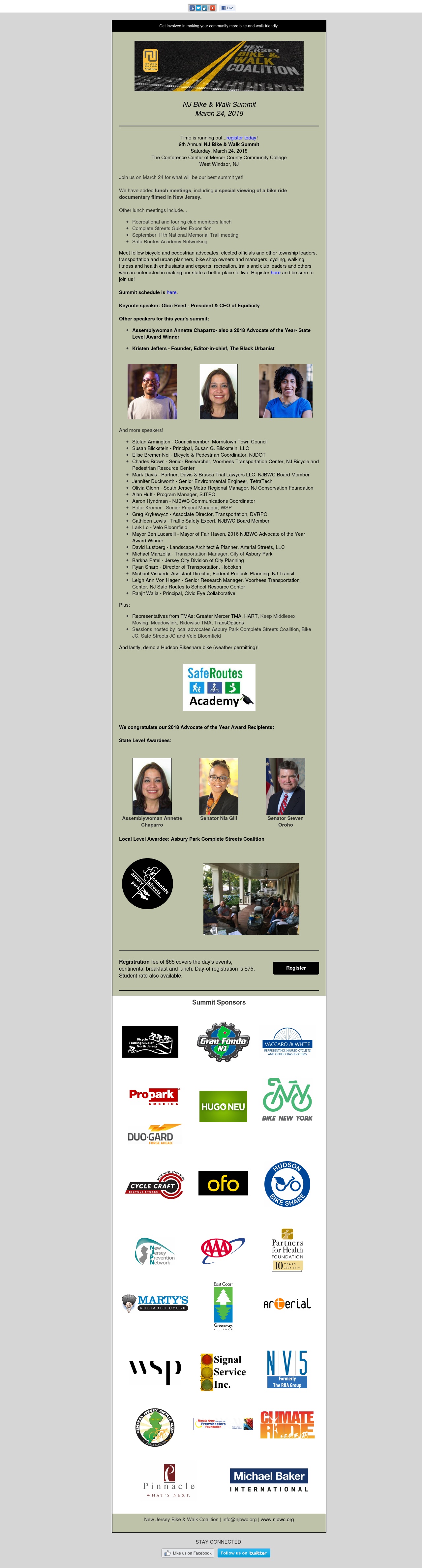
On Saturday, March 24th the Asbury Park Complete Streets Coalition was awarded the 2018 Advocate of the Year, Local Level at the New Jersey Bike and Walk Summit, to recognize the advocacy work the organization has done.
The summit’s theme this year was “Toward an Equitable Future”. Speakers and panelists stated that socioeconomically disadvantaged groups rely on cycling and walking and public transit, and that equity requires that these modes of transportation be made safe for everyone.
Speakers included Oboi Reed, of Equicity and Slow Roll, Chicago and Kristen Jeffers of Black Urbanist.
What is the meaning of “Share The Road” signs? Is sharing even possible?
Cars, bicycles and the fatal myth of equal reciprocity
At times as a cyclist among the cars I feel like an insurgent in hostile territory. By now some readers might assume I am advocating cyclist rebellion and lawless riding. I’m not. Cyclists should do their best to be civil and rule-abiding on the road, at least where it doesn’t put us in danger.
At the same time, we can’t expect great or immediate results from this offer of reciprocity to the drivers around us. To suggest that the person at the wrong end of a heavily unequal relationship can gain recognition and equality simply by offering to “respect the space” of the dominant subject is wishful thinking.
When cyclist meets driver on the road, both are notionally equal individuals encountering each other in a democratic, rule-governed and neutral public space. But only if the driver chooses to make it like this. Otherwise, they are in a deeply asymmetrical relation, both physically and culturally.
AP COMPLETE STREETS COALITION WILL ADMINISTERS SATURDAY PANEL ON GROWING JERSEY SHORE NETWORK
The Asbury Park Complete Streets Coalition will be participating in the New Jersey Bike & Walk Summit on Saturday, March 24th at Mercer County Community College in West Windsor, NJ. The Summit is organized annually by the New Jersey Bike & Walk Coalition. Details about the Summit can be found at http://njbwc.org/summit-2018/ .
The keynote speaker at this year’s Summit will be Oboi Reed, an urbanist and advocate for equitable streets in minority and traditionally underserved neighborhoods. Mr. Reed’s talk about community equity should be very relevant to Asbury Park.
The Asbury Park Complete Streets Coalition will be receiving an award for advocacy and we will be expressing our appreciation to our mayor and council for helping Asbury Park evolve into a statewide leader for safe, inclusive and accessible streets.
We will also be hosting a session about expanding Complete Streets principles in the Jersey Shore area titled “Jersey Shore Complete Streets Workshop.” The goal of our workshop session is to think about improvements to our pedestrian, bike and transit networks beyond our municipal borders is the Jersey shore region.
For too long biking has been viewed skeptically as a white-people thing, a big city thing, an ultra-fit athlete thing, a twenty-something thing, a warm weather thing or an upper-middle class thing. And above all else, it’s seen as a guy thing.
But guess what? The times they are a changing. More than 100 million Americans rode a bike in 2014, and bicycles have out-sold cars most years in the US since 2003. A couple other facts that may surprise you:
Latinos bike more than any other racial group, followed by Asians and Native Americans. African-Americans and Caucasians bike at about the same rate.
Most bicyclists are low-income according to census figures — as many as 49 percent of bike commuters make less than $25,000 a year.
I never learned to ride a bicycle. And yet I am an active member of an organization dominated by bicycle riders, and is often focused on increasing the number of urban bike lanes. Why?
Because I believe that walkers benefit from bike lanes as well. Here’s why: when a traffic lane is devoted to bicycles and taken away from cars, this means that the remaining lanes are either narrower or there are fewer of them. As a matter of common sense, it seems obvious that motorists drive more slowly on narrower streets. And when motorists drive more slowly, they are less dangerous to walkers or to each other.
As cities work to add technologies to improve residents’ lives and mobility, many are putting a renewed focus on inclusivity and equitable innovation distribution. Yet despite this inclusivity push, experts say people with disabilities remain an overlooked group, especially during city planning processes.
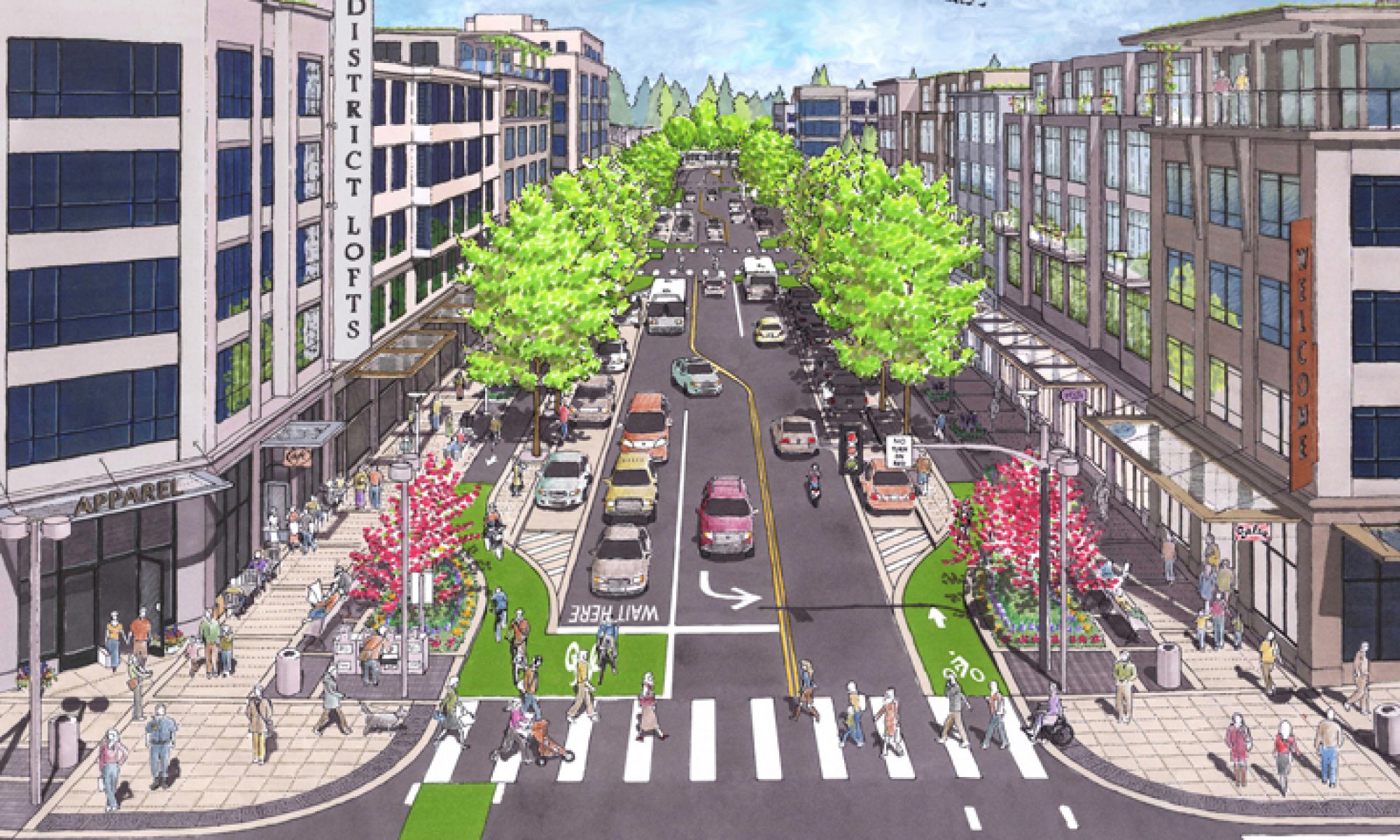
Main Street in Asbury Park gets $19 million makeover
Austin Bogues March 20, 2018
“The goal of the road diet is to decrease travel time through the Main Street corridor and create a safer, more efficient traffic flow. This will help with pedestrian and bicycle safety and improving emergency services response time…”